
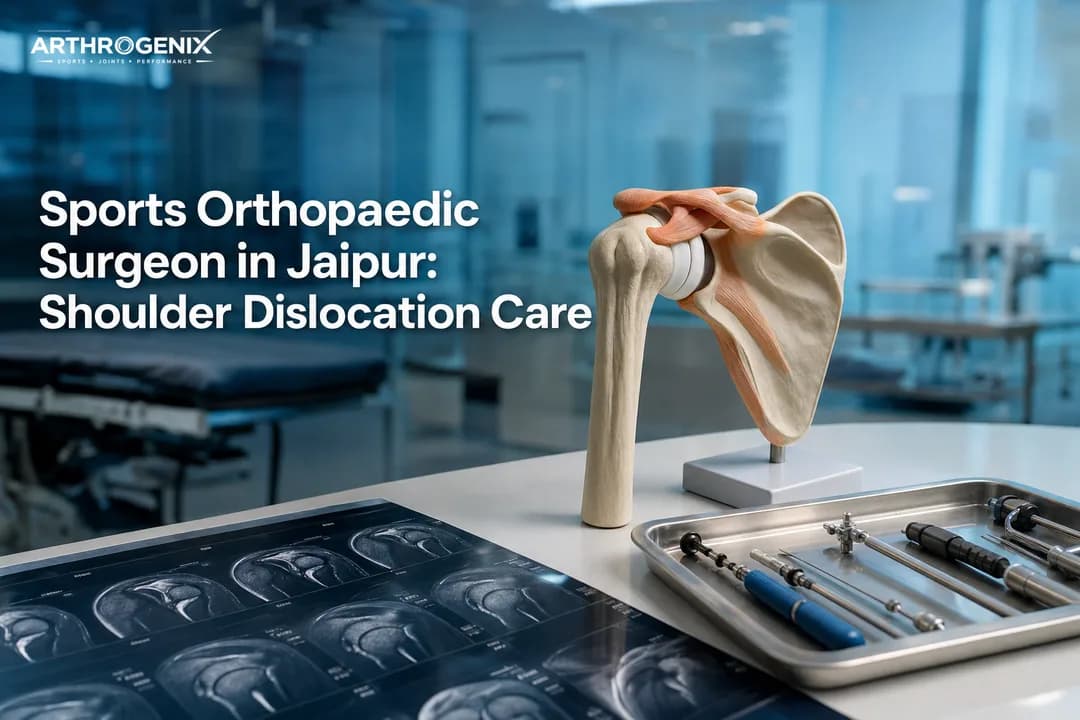
Sports Orthopaedic Surgeon in Jaipur: Shoulder Dislocation Care is a practical guide for anyone who wants safer decisions after a pop, slip, or sudden shoulder “give way.” If you are searching for a sports orthopaedic surgeon, this article explains what to do first, what to avoid, how doctors confirm damage, and how return-to-sport planning works in Jaipur.
Why Shoulder Dislocations Need Early, Structured Care
First, a dislocated shoulder means the ball of the upper arm shifts out of the socket. Because the shoulder trades stability for mobility, it dislocates more often than other joints. As a result, the same injury can range from “simple” to complex, depending on age, sport, and tissue damage.
Importantly, pain is only one part of the story. Many athletes feel intense pain at first, then feel “better” after the joint goes back in place. However, the stabilizers may still be torn. If you skip proper evaluation, repeated instability becomes more likely over time.
In our day-to-day sports injury treatment Jaipur, we often meet people who self-treated with a sling for weeks. Later, they report a second dislocation during a throw, swim stroke, or even while putting on a shirt. Therefore, early diagnosis and a clear plan usually save time, money, and confidence.
What Usually Gets Injured When the Shoulder Pops Out
Most traumatic dislocations affect the labrum, capsule, and ligaments. For example, a Bankart-type labral tear can make the joint feel loose. In addition, bone injuries can occur on the socket or the humeral head, which changes treatment choices.
Notably, nerves and blood vessels can also get irritated during a dislocation. That risk stays low, yet it matters. If you notice numbness over the outer shoulder or weakness lifting the arm, you should seek urgent assessment.
Common Clues That Point to Instability
- A feeling that the shoulder will “slip” during overhead motion
- Fear when you move the arm back to throw or serve
- Repeated episodes after the first dislocation
- Clicking with pain, especially in the front of the shoulder
- Night pain after activity, even when resting
First Aid After a Dislocation: What to Do and Avoid
First, treat a suspected dislocation as urgent. Support the arm in the position that feels safest. Next, apply a cold pack over cloth for short intervals to reduce swelling. Then get medical help for reduction and assessment.
However, avoid forceful self-reduction or “friends fixing it.” That approach can worsen a tear, pinch a nerve, or create fractures. Similarly, do not keep testing your range to “check if it’s okay.” Instead, protect the joint until a clinician evaluates it.
Also, avoid heat and aggressive massage in the first day. Those can increase swelling. Finally, if you see deformity, severe pain, tingling, or color change in the arm, go to emergency care immediately.
How a Sports Orthopaedic Surgeon Evaluates a Dislocated Shoulder
A sports orthopaedic surgeon focuses on stability, tissue quality, and your sport demands. First, the doctor listens to the injury story. For instance, a fall with the arm out can suggest anterior instability. Next, they check strength, sensation, and vascular status.
After that, imaging confirms the diagnosis and rules out fractures. X-rays help check alignment and bone injury. If your symptoms suggest labral or rotator cuff damage, MRI often adds useful detail. In addition, the plan depends on age, recurrence, and contact risk.
To support informed decision-making, recognized guidance notes that shoulder dislocations commonly recur, especially in young active people. For example, AAOS OrthoInfo on dislocated shoulder explains the injury pattern, evaluation, and treatment options in patient-friendly terms.
When Arthroscopy Helps, and When Other Options Fit Better
Many instability repairs happen through keyhole surgery. In that setting, an arthroscopy surgeon Jaipur can repair a torn labrum and tighten the capsule. Therefore, arthroscopy often suits athletes who need a stable shoulder for overhead or contact sports.
However, surgery is not one-size-fits-all. If a scan shows significant bone loss, the surgeon may discuss bone-augmenting procedures rather than only soft-tissue repair. Similarly, if the dislocation relates to laxity without a major tear, rehabilitation may take center stage.
For deeper reading on arthroscopy and sports-related shoulder issues, you can also review research collections at PubMed. It is a searchable database of peer-reviewed medical studies.
Treatment Paths: Rehab, Bracing, or Surgery in Jaipur
First, many first-time dislocations without major tissue damage start with guided physiotherapy. The goal is simple. Build control of the rotator cuff and shoulder blade muscles. As a result, the socket centers better during motion.
Second, bracing can help in specific sports. However, bracing rarely replaces strength and control. Therefore, most athletes still need a structured program before they return.
Third, surgery becomes more relevant when instability recurs or when sport risk stays high. In that case, minimally invasive repair can restore stability and protect cartilage. Still, outcomes vary with age, tissue quality, and rehab effort. So no honest doctor can guarantee a fixed timeline for every athlete.
At ArthroGenix, Dr Abhishek Saxena and our team typically map a stepwise plan. We match it to your goals, sport calendar, and imaging findings. That approach helps patients stay realistic and motivated.
Return-to-Play Is a Criteria Checklist, Not a Date
It feels tempting to ask, “When can I play again?” However, the better question is, “What do I need to pass to play safely?” Most return-to-play decisions use criteria such as pain control, range, strength symmetry, and sport-specific drills.
Moreover, a good plan tests confidence. For example, a cricketer must tolerate controlled throwing progressions. Similarly, a swimmer needs endurance without sharp front-shoulder pain. Therefore, the final green light comes from function, not the calendar.
To illustrate how structured pathways reduce re-injury, sports medicine bodies emphasize graded loading and objective testing. You can explore consensus statements and learning resources via the British Journal of Sports Medicine, which publishes return-to-sport and injury-prevention guidance.
Choosing the Right Orthopaedic Surgeon in Jaipur for Athletes
First, look for a clinician who treats shoulder instability regularly, not occasionally. Ask how they decide between rehab, arthroscopy, and other procedures. Then ask what rehab milestones they use before clearance.
Second, check whether your doctor coordinates closely with physiotherapists. That teamwork matters for overhead athletes. In addition, confirm you will get a written plan that covers sleep, sling use, pain control, and exercises.
Third, experience with sports-specific demands makes a difference. In our clinic, we see patterns across gym training, cricket, badminton, and swimming. For example, poor scapular control often drives impingement-like pain after a dislocation. Therefore, we correct mechanics early, not only strength.
If you want to learn more about our approach to shoulder care and sports injury management, visit Jaipur sports orthopaedic care at ArthroGenix. You will find clear next steps for consultation and planning.
In summary, Sports Orthopaedic Surgeon in Jaipur: Shoulder Dislocation Care comes down to fast assessment, the right imaging, and a rehab plan you actually follow. If you are still unsure about instability, consult a sports orthopaedic surgeon for a balanced opinion and a transparent recovery pathway that fits your sport and your life.