
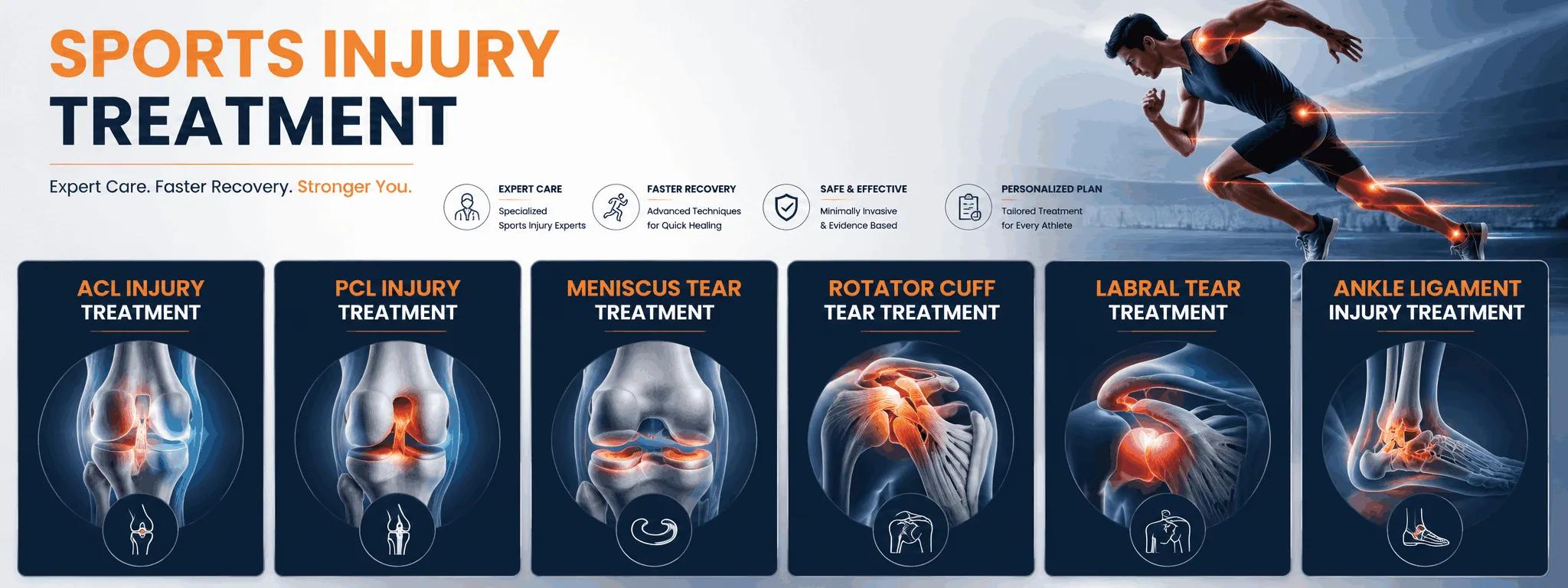
What the sports injury clinic does
The clinic sees competitive athletes, weekend players, gym-goers and runners. Each visit aims to answer three things: what exactly is injured, whether it needs surgery, and when you can safely play again.
Dr. Abhishek Saxena trained in arthroscopy and sports medicine, holds a FIFA Diploma in Football Medicine, and worked at the Centre for Sports Medicine at Kokilaben Dhirubhai Ambani Hospital, Mumbai. Treatment runs from physiotherapy and injections to keyhole surgery and joint-preserving procedures.
Common injuries by sport
| Sport | Common injuries |
|---|---|
| Cricket | Rotator cuff and shoulder overuse in throwers and bowlers, ACL and meniscus tears, finger and wrist injuries |
| Football | ACL and meniscus tears, ankle sprains, hamstring and groin strains |
| Kabaddi | ACL and collateral ligament tears, meniscus tears, shoulder dislocation |
| Badminton and tennis | Rotator cuff problems, tennis elbow, Achilles injuries, ankle sprains |
| Running | Runner's knee, shin pain, stress injuries, Achilles problems |
| Gym and weightlifting | Rotator cuff and labral injuries, shoulder instability, knee and back strain |
From injury to diagnosis
- 1
Early advice
Call or WhatsApp with what happened. You get advice on rest, support and how soon to be seen.
- 2
Examination
A hands-on assessment of the injured joint, its stability and your movement.
- 3
Same-week MRI when needed
If the examination points to an internal injury, MRI is arranged within the week so the plan does not wait.
- 4
A plan with your sport in mind
Options from physiotherapy to surgery, with your season, position and goals taken into account.
The return-to-play protocol
Time alone does not clear you. Each stage has to be passed before the next begins.
Stage 1: Settle
Control pain and swelling, restore full movement and protect the injured or repaired tissue.
Stage 2: Strengthen
Rebuild strength and balance under physiotherapy, comparing the injured side with the other.
Stage 3: Run and move
Straight-line running, then changes of direction, landing and agility as control returns.
Stage 4: Train for your sport
Sport-specific drills and non-contact practice, building up load gradually.
Stage 5: Cleared to play
Strength, hop and control tests are passed, and you return to full training and then competition.
Teams and academies
Coaches and academies can contact the clinic about injury assessment and return-to-play planning for their players.
Common sports injury treatments
ACL reconstruction
Rebuilds a torn knee ligament for pivoting sport.
Knee arthroscopy
Keyhole treatment of meniscus and cartilage problems.
Rotator cuff repair
Re-attaches torn shoulder tendons to the bone.
Shoulder instability surgery
Stabilises a shoulder that keeps dislocating.
Ankle ligament treatment
Care for sprains and an ankle that keeps giving way.
Meniscus repair
Saves torn knee cartilage where possible.
Questions patients ask
No official ranking exists, so look for sports medicine training, experience with your injury and a structured return-to-play plan. Dr. Abhishek Saxena holds a fellowship in arthroscopy and sports medicine and a FIFA Diploma in Football Medicine, and sees patients at Durgapura and Vaishali Nagar.
See a doctor within a few days if pain, swelling or weakness is not settling, or if a joint feels unstable. Go the same day if you cannot bear weight, a joint looks deformed, or the joint locked or dislocated.
Not always. An examination comes first, and many injuries are diagnosed without one. MRI is used when a ligament, meniscus or tendon tear is suspected, and the clinic arranges it within the week when needed.
Many sports injuries recover with physiotherapy and a planned return to activity. Surgery is considered for injuries such as a complete ACL tear in a pivoting athlete, a repairable meniscus tear or repeated dislocation.
It depends on the injury. A mild sprain may take weeks, while competitive sport after ACL reconstruction typically takes 6 to 9 months. You return when strength and control tests are passed, not by the calendar alone.
Usually only for the first days. Long rest weakens muscles and stiffens joints, so guided movement and strengthening normally start early. Ask for advice specific to your injury before returning to sport.
Yes. The clinic treats weekend cricketers, runners, gym-goers and school players as well as competitive athletes, with the plan built around each person's sport and goals.
Yes. Bring your MRI and any earlier reports, or send them on WhatsApp. You will get a clear view of whether surgery is needed and what the alternatives are.