
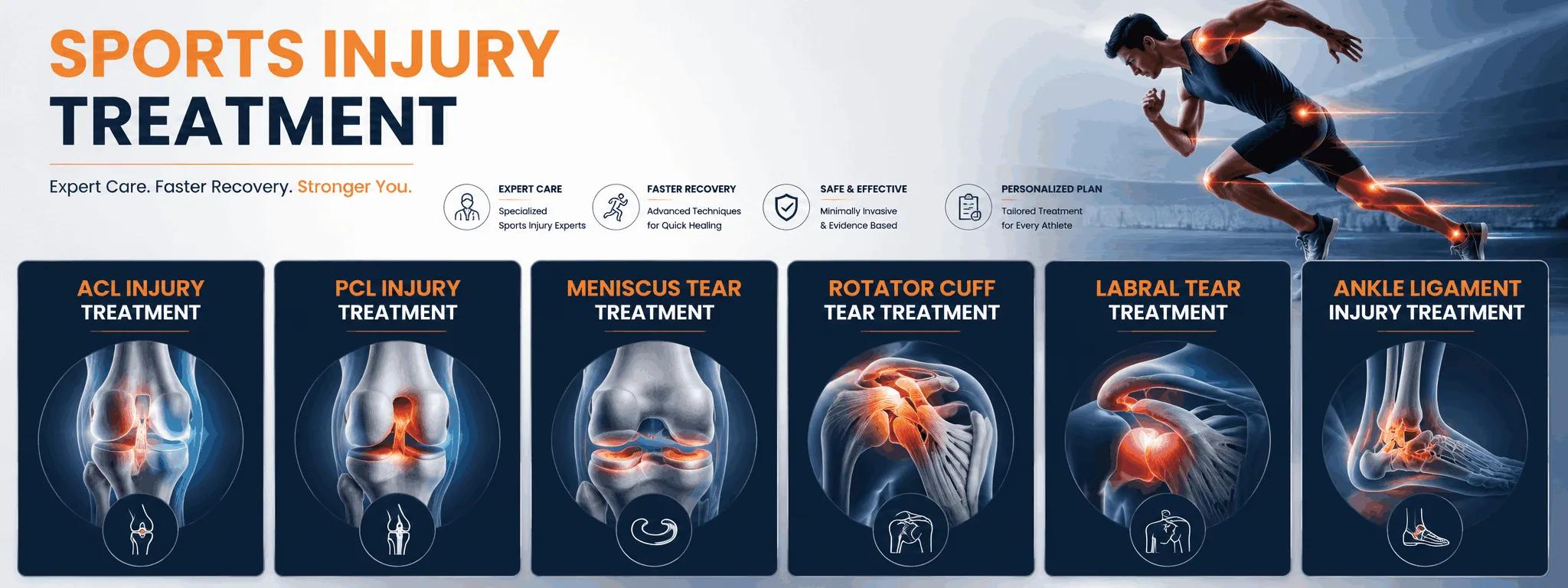
What team-doctor support covers
Injury-prevention session
A talk and practical session for players and coaches on warm-ups, landing, load and early warning signs.
Pre-season check
A look at players returning from injury and those with knee, shoulder or ankle problems before the season starts.
On-field injury guide
What coaches and physios do in the first minutes after an injury, and when a player must stop.
Quick assessment
A direct number for injured players, an examination within days, and MRI within the week when needed.
Return-to-play plan
A staged plan with test-based clearance, shared with the coach when the player agrees.
Surgery when needed
Keyhole ligament, meniscus and shoulder surgery at Shalby Hospital, Vaishali Nagar.
The first minutes after an injury
For coaches, physios and team managers. This is general first aid, not a diagnosis.
- 1
Stop play and assess
Stop the player, check breathing and responsiveness first, and do not move them if a neck or back injury is possible.
- 2
Head injury means off for the day
Any player with a suspected concussion leaves the game and does not return that day, even if they say they feel fine.
- 3
Protect the injured joint
Help the player off without putting weight through a painful knee or ankle. Support an injured arm in a sling.
- 4
Cold, compression, raise
Wrap ice in a cloth and apply for 15 to 20 minutes, use a firm bandage and keep the limb raised. Avoid heat and massage for the first two days.
- 5
Write down what happened
Note how the injury happened, whether there was a pop, and whether the joint gave way. It helps the diagnosis.
Go to hospital the same day if
- The player cannot put weight on the leg or use the arm
- A joint or bone looks out of shape
- A shoulder or kneecap has come out of place
- There is numbness, tingling or a cold, pale hand or foot
- There was a head injury with confusion, vomiting or loss of consciousness
- A wound is deep or bone can be seen. Call 108 or 112 for an ambulance
The return-to-play protocol
Time alone does not clear a player. Each stage has to be passed before the next begins.
Stage 1: Settle
Control pain and swelling, restore full movement and protect the injured or repaired tissue.
Stage 2: Strengthen
Rebuild strength and balance under physiotherapy, comparing the injured side with the other.
Stage 3: Run and move
Straight-line running, then changes of direction, landing and agility as control returns.
Stage 4: Train for your sport
Sport-specific drills and non-contact practice, building up load gradually.
Stage 5: Cleared to play
Strength, hop and control tests are passed, and you return to full training and then competition.
How a tie-up works
- 1
Get in touch
The association, club or academy calls or WhatsApps +91 96100 26600.
- 2
Agree the plan
A meeting with coaches about the sport, the season calendar, the number of players and what support helps most.
- 3
Put it in writing
What each side provides is agreed in writing. A team is named on this website only after that.
- 4
Start the season
An injury-prevention session at your ground, and a direct route to assessment for injured players.
Teams and federations served
Teams, academies and federations are listed here once a tie-up is agreed in writing. Player case studies appear only with the player's written consent.
Towns near Jaipur
Sports bodies in these towns can ask about support. Each page has the distance, driving time and camp dates.
Questions patients ask
He offers team-doctor support to sports bodies in Jaipur and nearby districts: injury-prevention sessions, quick assessment of injured players and a tested return to play. Teams that have agreed a tie-up in writing are listed on this page.
It is FIFA's course in the medical care of footballers, covering injury prevention, on-field emergencies and the common injuries of the sport. Dr. Saxena also holds a fellowship in arthroscopy and sports medicine.
Stop the player, help them off without putting weight through the knee, and apply ice wrapped in a cloth with a firm bandage. Go to hospital the same day if the player cannot bear weight or the knee looks out of shape.
When strength, hop and control tests are passed, not by the calendar alone. A mild sprain may take weeks, while competitive sport after ACL reconstruction typically takes 6 to 9 months.
Yes. Sports bodies in Ajmer, Kishangarh, Sikar, Jhunjhunu, Alwar, Bhiwadi, Dausa, Tonk, Sawai Madhopur and Kotputli can ask about support. Sessions at your ground are planned with the team.
Players or coaches call or WhatsApp +91 96100 26600 with what happened. The player is examined within days, and MRI is arranged within the week when the examination points to an internal injury.