
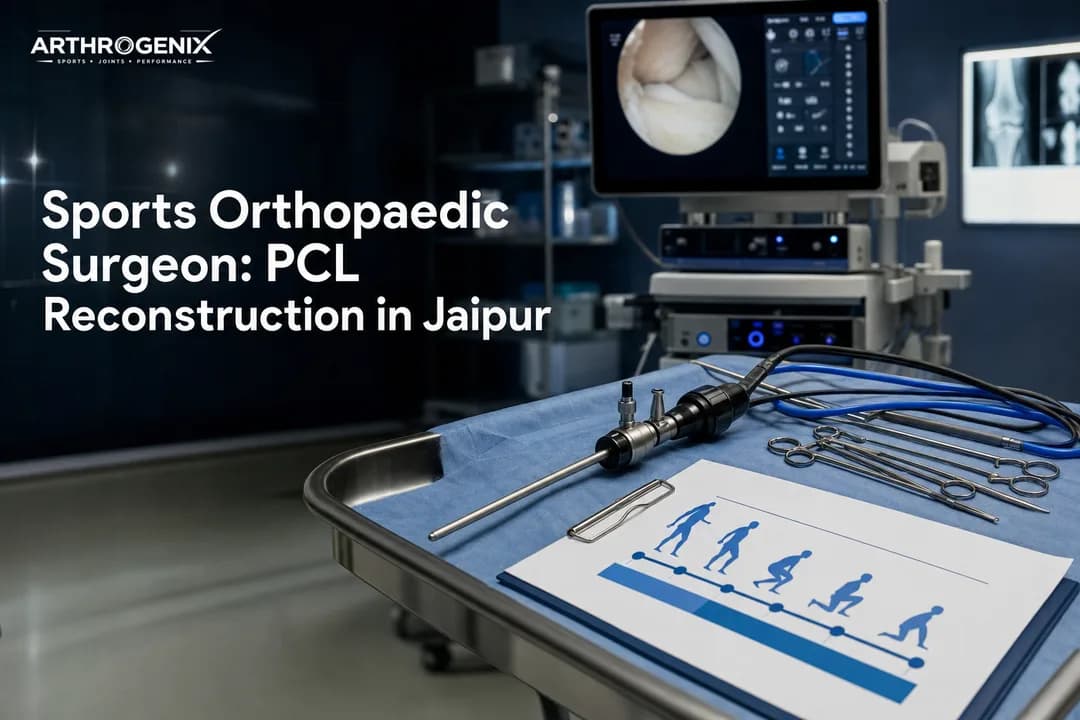
If you are searching for a sports orthopaedic surgeon after a PCL injury, the article PCL Reconstruction in Jaipur: Return-to-Sport Timeline explains what recovery usually looks like and how to plan a safe comeback. Importantly, it also shows what “ready” means in sports medicine, not just “pain-free.” Because every knee and every sport differ, you will learn the milestones that matter and the red flags to avoid.
Why PCL Injuries Change Sport Plans
The posterior cruciate ligament (PCL) sits deep in the knee and resists the tibia sliding backward. Therefore, when it is torn, athletes often notice instability on deceleration, downhill running, or landing from a jump. In addition, swelling and a “heavy knee” feeling can limit training volume.
Some PCL tears recover with rehab alone, especially lower-grade injuries. However, complete tears, combined ligament injuries, or ongoing instability may need reconstruction. Your surgeon also considers your sport, pivoting demands, and whether the knee shows progressive laxity over time.
Notably, PCL rehab tends to protect the graft from early posterior stress. As a result, the timeline differs from many ACL plans. You may feel strong early, yet the biology of healing still sets the pace.
Sports Orthopaedic Surgeon Assessment Before Surgery
A good return-to-sport plan starts before the operation. First, a detailed history clarifies the injury mechanism, the sport level, and what movements provoke giving-way. Next, an exam checks posterior drawer, posterior sag, and overall alignment.
MRI helps confirm the tear and reveals other problems, such as meniscus injury or cartilage damage. In addition, X-rays may assess alignment or old avulsion fragments. Your treatment path changes if the injury includes the posterolateral corner or other stabilizers.
What We Focus On In Clinic
In our work with athletes and active professionals at ArthroGenix in Jaipur, a pattern we repeatedly see is this: people judge readiness by pain alone. However, the knee can feel fine while strength and control still lag. Therefore, we track functional movement and side-to-side strength differences, not only symptoms.
We also set expectations early. For example, some athletes return to non-contact training earlier than they return to match intensity. That clarity reduces risky “testing the knee” moments.
Key Prehab Targets That Speed Rehab Later
- Full extension and comfortable flexion without flare-ups
- Quad activation and endurance, since quads protect the PCL
- Hip and core control to reduce knee overload
- Swelling control through smart activity and compression
Importantly, prehab does not mean aggressive loading. Instead, it means steady range, calm swelling, and clean movement quality.
Sports Orthopaedic Surgeon Return-to-Sport Timeline
The timeline below reflects common, evidence-based milestones after PCL reconstruction. Still, your exact plan depends on graft choice, associated injuries, and your rehab response. Consequently, your surgeon and physiotherapist should adjust progressions based on objective testing.
To understand why patience matters, it helps to remember that graft healing and remodeling takes months. In fact, the broader ligamentization process after cruciate reconstruction is commonly discussed in orthopaedic research literature. For a clinical overview of knee ligament injury and reconstruction principles, you can also review trusted medical references such as the MedlinePlus knee injury resource.
Phase 1: Weeks 0–6 (Protection And Control)
First, the goal is to protect the reconstruction while controlling pain and swelling. Therefore, many protocols limit hamstring-loaded actions early, because hamstrings can pull the tibia backward. Your team may also use a brace to control posterior sag.
Next, rehab emphasizes quad activation, safe range of motion, and normal gait mechanics. Moreover, swelling management remains a daily priority. If swelling persists, strength gains slow down.
During this phase, athletes usually focus on upper-body conditioning and non-impact cardio options that the rehab team approves. Importantly, rushing into deep knee bends or resisted hamstring curls can set you back.
Phase 2: Weeks 6–12 (Strength Base And Movement Quality)
As motion improves, you build strength and confidence. Specifically, rehab often progresses closed-chain strengthening with careful knee angles. In addition, balance drills and step patterns restore control.
At this stage, many people feel “almost normal” in daily life. However, sport loads are different. Therefore, your therapist should test single-leg control, swelling response, and quad strength before you add impact.
Meanwhile, if you also had meniscus repair or cartilage work, restrictions may last longer. As a result, the combined procedure often dictates the pace more than the PCL alone.
Phase 3: Months 3–6 (Running Progression And Power)
Typically, athletes start a graded running program once strength and control meet targets. For example, your team may require near-symmetry in quad strength and no swelling after harder sessions. Consequently, “jogging a little” becomes “running well” only through structured progression.
Next, rehab adds plyometrics, deceleration mechanics, and change-of-direction basics. Importantly, these skills must look clean on video and during fatigue. If your knee collapses inward late in a set, you are not ready for match intensity.
For clinical background on knee ligament function and injury patterns, resources like the AAOS OrthoInfo page on PCL injuries provide reliable, patient-focused explanations.
Phase 4: Months 6–9+ (Sport-Specific Training To Return)
Finally, you shift from “rehab” to performance training. Therefore, you add reactive drills, cutting at speed, contact preparation when relevant, and sport-specific conditioning. In addition, you reintroduce training density, such as back-to-back days, to mimic real seasons.
Many athletes return to non-contact practice earlier than they return to full competition. However, the final decision should follow objective criteria, not a calendar date. Moreover, fear of reinjury can limit performance, so confidence work matters too.
Because outcomes vary, we avoid guarantees. For example, a high-demand pivoting athlete with a combined injury may need longer than a recreational runner. Still, a structured plan helps most athletes return with better long-term knee health.
Criteria That Matter More Than The Calendar
A safe return-to-sport decision uses measurable checkpoints. First, you want stable symptoms: no swelling after training, no giving-way, and predictable soreness. Next, you need objective strength and control targets that match your sport demands.
Importantly, modern sports medicine emphasizes testing over guesswork. For example, many programs use limb symmetry indices and functional hop tests, along with movement analysis. Research often reports that returning before meeting strength criteria can increase reinjury risk in cruciate populations. For a broader view of return-to-sport concepts and knee rehabilitation research, you can browse peer-reviewed studies on PubMed.
- Quad strength symmetry close to the uninjured side
- Controlled single-leg squat without valgus collapse
- Good deceleration mechanics on cuts and landings
- No effusion the day after higher loads
- Sport-specific conditioning that matches game intensity
In addition, your surgeon may assess posterior stability clinically before clearing you. If instability persists, returning too early can stress cartilage and meniscus over time.
Choosing Care In Jaipur And Next Steps
If you want care that combines diagnosis, arthroscopy expertise, and structured rehab planning, start with a clear evaluation. At ArthroGenix, Dr Abhishek Saxena evaluates athletes and active individuals for ligament injuries, including PCL and combined knee instability. Moreover, the clinic’s focus on minimally invasive arthroscopy and joint preservation supports long-term function, not only short-term return.
Before you book, note a practical limitation: the same surgery can produce different timelines because biology, associated injuries, and rehab consistency differ. Therefore, ask your surgeon to explain your specific constraints, including brace use, hamstring restrictions, and sport-specific milestones.
If you are comparing options for an orthopaedic surgeon in Jaipur, look for a team that communicates in phases and uses criteria-based testing. In addition, choose a plan that includes progression rules for swelling and pain, so you know when to push and when to hold.
To discuss your goals and map a safe comeback, you can explore Jaipur sports orthopaedic care at ArthroGenix. In the end, PCL Reconstruction in Jaipur: Return-to-Sport Timeline works best when a sports orthopaedic surgeon aligns surgery, rehab, and sport demands with honest checkpoints and patient-specific pacing.
As a dedicated sports orthopaedic and joint care practice in Jaipur, we share guidance rooted in day-to-day clinical decision-making and rehabilitation planning, so athletes can return with clarity and confidence.