
Sports Orthopaedic Surgeon in Jaipur for ACL Decisions is a practical guide for anyone searching for a sports orthopaedic surgeon after a knee twist, pop, or repeated “giving way.” You will learn what an ACL tear really means, when surgery helps, how graft choices differ, and what recovery looks like in real life.
Why ACL Tears Feel Confusing at First
ACL injuries often happen fast, but the decisions do not. First, pain and swelling can hide key exam findings. Second, online advice mixes athlete timelines with non-athlete needs. As a result, many people delay the right work-up.
In Jaipur, we commonly see ACL injuries from football, badminton, cricket, and gym mishaps. However, road slips and stair missteps also tear the ligament. Therefore, you should treat the first two weeks as a diagnosis window, not a “wait and hope” phase.
What The ACL Does And Why “Giving Way” Matters
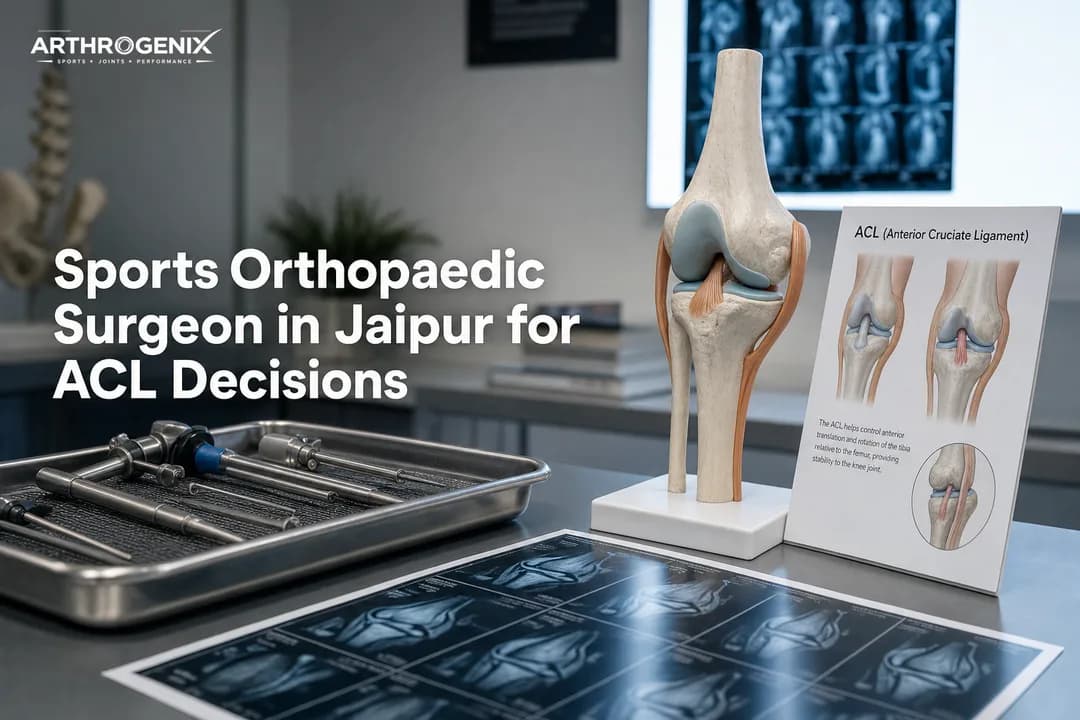
The ACL limits forward movement of the tibia and controls rotation. Consequently, a torn ACL often causes instability during pivoting. You may notice the knee buckles when you turn, descend stairs, or step off a curb.
Importantly, repeated instability can damage the meniscus and cartilage. Over time, that can increase the risk of early wear changes. Because of that, the goal is not only pain relief. The goal is joint protection and safe function.
How A Specialist Confirms An ACL Tear
First, a clinician correlates your story with stability tests such as the Lachman test. Next, imaging helps rule out fractures and check for associated injuries. MRI often maps meniscus tears, bone bruising, and cartilage defects.
Notably, MRI sensitivity for ACL tears is high, but interpretation still depends on quality and the radiologist’s experience. Therefore, a sports-focused exam remains essential. If swelling limits the exam on day one, a repeat assessment after swelling settles often clarifies the picture.
Sports Orthopaedic Surgeon: When ACL Surgery Helps Most
A sports orthopaedic surgeon usually recommends ACL reconstruction when instability blocks daily life or sports goals. In addition, associated injuries can tip the decision toward surgery. On the other hand, some people manage well with rehab and activity changes.
In our day-to-day work at ArthroGenix, a pattern we repeatedly see is this. People who try to “push through” instability often return later with a new meniscus tear. Therefore, we frame the decision around stability events, sport demands, and knee health, not just MRI words.
Checklist: Strong Reasons To Consider Reconstruction
Use this as a conversation starter with your knee specialist. Importantly, no checklist replaces an exam. Still, it helps you organise your priorities.
- Recurrent knee giving way during routine turns or stairs
- Pivoting sports goals such as football, basketball, badminton, or kabaddi
- Combined injuries, such as meniscus tears needing repair
- High-demand work that involves squatting, climbing, or uneven ground
- Failure of structured rehab to restore confidence and control
However, results vary with age, cartilage condition, commitment to rehab, and timing. Therefore, an honest prehab plan and clear expectations matter as much as the operation.
When Rehab-First Can Be Reasonable
Rehab-first can work if you have no instability episodes and you accept activity modification. Similarly, some partial tears respond well to strengthening and neuromuscular training. Yet you still need follow-up, because symptoms can change once you resume sport.
Graft Choice, Cost Drivers, And Jaipur Planning
Many people search “ACL reconstruction Jaipur cost” on day one. That is understandable. Still, the safest way to budget is to understand what drives the plan. Graft type, fixation implants, hospital facility, anaesthesia approach, and additional repairs all affect the final estimate.
In addition, costs change if the surgeon repairs the meniscus or addresses cartilage injury treatment in the same sitting. Therefore, ask for an itemised estimate after your exam and MRI review. That approach avoids surprises.
Common Graft Options And Their Trade-Offs
Surgeons most often use an autograft, which comes from your own tissue. The two common autografts are hamstring tendon and bone-patellar tendon-bone (BPTB). Some cases also use quadriceps tendon. Each option has pros and cons based on sport, kneeling needs, and anatomy.
For example, hamstring grafts often reduce front-knee kneeling pain. However, some athletes need focused hamstring strengthening after surgery. In contrast, BPTB grafts provide strong bone-to-bone healing. Yet they can increase the chance of anterior knee pain in some patients, especially with frequent kneeling.
Evidence syntheses help guide these choices. A large Cochrane review discussed outcomes and complications across graft types, including differences in anterior knee pain and graft failure patterns. See the review summary on Cochrane Library evidence on ACL graft choices.
Recovery Timeline: What “Return To Sport” Really Means
Recovery has milestones, not magic dates. First, you control swelling and regain full extension. Next, you rebuild strength, balance, and landing mechanics. Finally, you earn return to sport through testing, not hope.
Importantly, returning too early raises re-injury risk. In fact, a widely cited cohort study found that young athletes who returned to knee-strenuous sport before 9 months had a higher rate of second ACL injury. You can read the details in the PubMed abstract on return-to-sport timing and reinjury risk. Therefore, many programs now emphasise criteria-based clearance.
A Practical Milestone Map You Can Expect
Every knee heals at its own pace. Still, the broad sequence stays similar. Moreover, your physio plan adapts if you also had meniscus repair Jaipur protocols, cartilage work, or PCL reconstruction Jaipur history.
- Early phase: swelling control, walking pattern, full extension, gentle flexion
- Strength phase: closed-chain strength, hip control, core stability, cycling
- Control phase: single-leg balance, deceleration drills, hop prep
- Sport phase: cutting mechanics, reactive agility, fatigue training
- Testing phase: strength symmetry, hop tests, movement quality, confidence checks
Meanwhile, your surgeon and physio should track objective measures, not just pain. Therefore, ask what metrics they use. Examples include quadriceps strength symmetry and quality of single-leg landing.
How To Choose The Right Surgeon And Clinic In Jaipur
When you compare an orthopaedic surgeon in Jaipur, look beyond titles. Instead, match the surgeon’s focus to your problem. ACL care sits at the intersection of arthroscopy, sports medicine, and rehab planning. Therefore, a team that aligns surgery with physiotherapy usually delivers smoother recoveries.
Also, choose a clinic that explains options in plain language. You should leave with a written plan for activity, pain control, and physiotherapy. In addition, you should know the warning signs that require urgent review.
Questions Worth Asking At Your Consultation
These questions keep the visit focused and help you compare providers fairly. Moreover, they reduce confusion when family members join decision-making.
- Do I have instability on exam, or only MRI findings?
- Do I need meniscus repair, or is it a stable tear?
- Which graft fits my sport and kneeling needs, and why?
- What is the rehab plan, and who coordinates it?
- What criteria do you use to clear return to play?
Notably, high-quality ACL care often includes injury-prevention training after you return. Programs such as the FIFA 11+ reduce football injury risk and provide a structured warm-up approach. You can review the framework at the FIFA Medical Network on the FIFA 11+ prevention program.
If you want a structured starting point, explore ArthroGenix in Jaipur for sports injury evaluation and arthroscopy-led knee care. You can also learn about Dr Abhishek Saxena’s approach to shoulder, knee, and sports injuries through the Jaipur sports orthopaedic team at ArthroGenix.
In conclusion, choosing a sports orthopaedic surgeon should feel like building a plan, not buying a procedure. If your knee keeps giving way, get assessed early, review graft options calmly, and commit to rehab. If you would like, book a consultation for a clear diagnosis and a personalised roadmap, with no pressure and realistic expectations.