
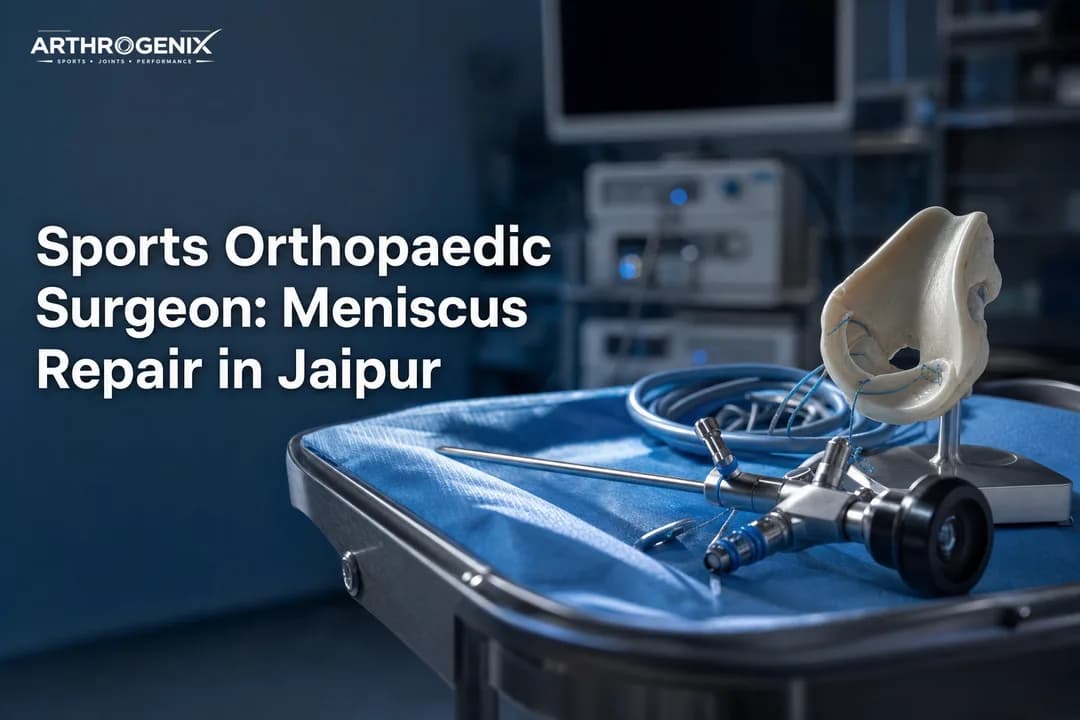
In the guide Meniscus Repair in Jaipur: Meniscectomy vs Repair Benefits, a sports orthopaedic surgeon explains how surgeons choose between trimming and stitching a torn meniscus. You will learn what each option means, who benefits most, and what recovery often looks like for active people in Jaipur.
Why Meniscus Tears Matter for Knee Stability
Your meniscus is a C-shaped cartilage cushion that helps the femur and tibia share load. Importantly, it also adds shock absorption and joint stability during twisting and deep bending. Because of that, a tear can change how your knee moves, especially in sports and daily stairs.
Often, meniscus tears happen during a pivot, a squat, or a sudden stop. However, they can also occur gradually from age-related wear. In both cases, the knee can start to “catch” or swell after activity.
At ArthroGenix, we frequently see people who kept playing through pain for weeks. As a result, swelling becomes recurrent and the knee feels unreliable. In our day-to-day work with athletes and working professionals in Jaipur, we also notice that early, accurate diagnosis makes decision-making much clearer.
Common Signs That Suggest a Meniscus Injury
First, many patients describe pain along the inner or outer joint line. Next, they report swelling that flares after activity. Similarly, some people feel a sharp pinch during squats or while getting up from the floor.
- Joint-line tenderness and pain on twisting
- Swelling that returns after running or long walks
- Locking, catching, or a “stuck” sensation
- Reduced knee bend or discomfort on deep flexion
- Feeling that the knee may “give way”
Still, not every painful knee has a meniscus tear. Therefore, your surgeon will correlate symptoms with an exam and imaging before recommending any procedure.
Sports Orthopaedic Surgeon Options for Meniscus Repair in Jaipur
When symptoms persist despite rest and physiotherapy, arthroscopy becomes an option. Arthroscopy uses a small camera and fine instruments through keyhole incisions. Consequently, it allows the surgeon to confirm the tear pattern and treat it in the same sitting.
Broadly, treatment falls into two surgical paths: meniscus repair (stitching the torn tissue) or partial meniscectomy (trimming the torn fragment). Importantly, the best option depends on tear location, tissue quality, stability of the tear, and your activity goals.
Meniscus Repair: When Stitching Makes Sense
Meniscus repair aims to preserve the cartilage. Therefore, it suits tears in the vascular “red-red” or “red-white” zones where blood supply can support healing. It also fits certain longitudinal, vertical, or root-related tears that destabilize the knee.
In practice, a surgeon may use all-inside, inside-out, or outside-in repair techniques. Notably, each method has different instrument choices and suture paths. However, the goal stays the same: restore the meniscus as a functional shock absorber.
Why Blood Supply Changes the Decision
The outer rim of the meniscus receives more blood flow than the inner rim. Because of that, outer-zone tears often heal better after repair. In contrast, inner-zone tears can struggle to heal, even with excellent technique and rehab.
Meniscectomy: When Trimming Is the Safer Choice
Partial meniscectomy removes only the unstable, torn piece while preserving as much rim as possible. For example, complex degenerative tears in the inner avascular zone often do not hold sutures well. In that case, trimming can relieve mechanical catching faster.
Even so, surgeons try to be conservative with trimming. In fact, preserving meniscus tissue supports long-term joint health. That is why you should ask how much tissue your surgeon expects to remove and what that means for your sport or work demands.
Meniscectomy vs Repair: Key Benefits and Trade-Offs
Both procedures can reduce pain and improve function. However, they differ in healing biology and recovery pacing. Therefore, the “best” procedure is the one that matches your tear pattern and your knee’s overall condition.
To ground this in evidence, the American Academy of Orthopaedic Surgeons overview of meniscus tears explains that tear type and location drive treatment choices, including repair versus partial meniscectomy. Similarly, many orthopaedic texts emphasise meniscus preservation when feasible.
Benefits of Meniscus Repair for the Right Tear
First, repair keeps more native cartilage in the knee. As a result, it can better maintain load distribution during running and jumping. Second, it can reduce the risk of future joint degeneration when compared with removing a large segment.
That said, repair needs protection while it heals. Consequently, you may need crutches longer, and sports return may take more time. Importantly, the tear must be repairable for these benefits to apply.
Benefits of Partial Meniscectomy for Specific Cases
Meniscectomy often gives faster relief from locking when a flap catches in the joint. Therefore, some patients return to desk work sooner. Also, rehab can be more straightforward when no repair needs protection.
On the other hand, removing meniscus tissue reduces shock absorption. Over time, that may increase cartilage stress. The NCBI overview on knee meniscus describes the meniscus role in load transmission and joint protection, which helps explain why surgeons aim to preserve tissue when possible.
What to Expect From Surgery and Recovery
Most meniscus procedures occur as day-care arthroscopy. Before surgery, your orthopaedic surgeon in Jaipur will review MRI findings, examine stability, and discuss goals like sport, trekking, or floor-sitting needs. After surgery, rehab becomes the main driver of outcome.
At ArthroGenix, we plan rehabilitation around the exact procedure performed. In addition, we consider whether an ACL reconstruction Jaipur plan runs alongside the meniscus work, since combined injuries change timelines.
Rehab Timelines: A Practical Comparison
With partial meniscectomy, patients often progress weight-bearing more quickly. In contrast, repairs usually need a more guarded early phase to protect sutures. Therefore, your physiotherapy plan will differ in the first few weeks.
Notably, return-to-sport decisions should be criteria-based, not calendar-based. Strength symmetry, swelling control, and hop or squat mechanics matter more than a fixed date. The Cochrane Library evidence summaries can help patients understand why outcomes vary across procedures and rehab approaches.
- First phase: control swelling, restore gentle motion, activate quadriceps.
- Second phase: build strength and balance with progressive loading.
- Third phase: introduce sport-specific drills and controlled pivots.
- Final phase: test readiness and reduce re-injury risk with technique work.
How ArthroGenix Helps You Choose the Right Path
Choosing between trimming and repair should never feel like guesswork. Instead, a knee surgeon Jaipur patients trust should explain the tear pattern, show MRI images, and clarify why one option suits your knee. Above all, the plan should align with your sport, age, and cartilage status.
When you consult at ArthroGenix, we focus on a structured approach: detailed history, precise clinical tests, and imaging review. Then we discuss non-surgical options when they remain reasonable. If surgery makes sense, we explain arthroscopy steps and rehab expectations in simple terms.
For many active patients, Dr Abhishek Saxena discusses meniscus preservation whenever it is feasible. However, we also state limitations clearly. Some tears cannot heal with sutures, and some knees have arthritis that changes the goal from “restore” to “relieve.”
In short, the most helpful consult is the one that matches the procedure to your knee, not the other way around. If you want a second opinion or a clear treatment plan, you can book an appointment through Jaipur sports orthopaedic care at ArthroGenix. Finally, remember that results vary with tear type, cartilage wear, rehab consistency, and any associated ligament injury. If you are comparing options in sports orthopaedic surgeon consultations, bring your MRI and list your activity goals so the decision stays patient-specific.