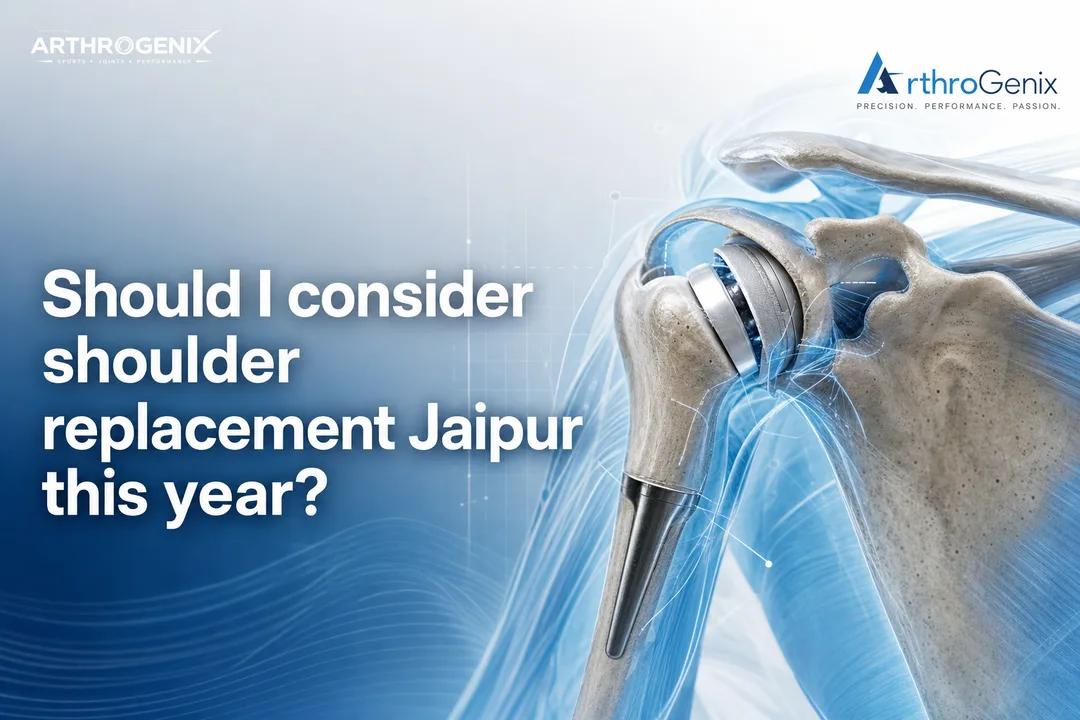
If you searched for a sports orthopaedic surgeon because your shoulder pain will not quit, you might be asking, “Should I consider shoulder replacement Jaipur this year?” In this guide, we explain how to judge timing, what modern surgery involves, and how ArthroGenix in Jaipur helps you decide with confidence.
Are you a candidate? Key signs and symptoms
Persistent pain that limits sleep or daily function is the first red flag. If your shoulder grinds, locks, or gives way, you should get a specialist assessment. Furthermore, advancing osteoarthritis, rheumatoid damage, or massive irreparable rotator cuff tears can make daily life exhausting.
At ArthroGenix, we see patterns. Many active adults push through pain for months. However, when pain blocks work, sport, and even dressing, they arrive ready for solutions. Not everyone needs an implant. Yet some benefit greatly when joint surfaces are too worn to salvage.
- Night pain despite medication and rest
- Severe stiffness with a shrinking range of motion
- Grinding or catching that worsens with use
- Failed relief after high-quality physiotherapy and injections
- Imaging that shows advanced arthritis or cuff tear arthropathy
Importantly, timing matters. Too early and you risk an unnecessary surgery. Too late and muscles weaken, which complicates recovery. Therefore, a measured, specialist-led pathway protects you either way.
When is shoulder replacement Jaipur the right option?
We weigh your story, goals, exam, and imaging. First, we optimise non-surgical care if the joint still has workable cartilage or a repairable rotator cuff. In addition, we use targeted injections to confirm the true pain source. When arthritis destroys the joint surface or the cuff cannot power the arm, replacement moves to the front of the line.
Conservative care vs surgery in Jaipur
Quality physiotherapy remains a cornerstone. For many, posture training, scapular control, and rotator cuff strengthening reduce pain. Anti-inflammatory strategies and activity tweaks also help. However, when X-rays show bone-on-bone change and daily function stalls, surgery may restore comfort and reach.
Red flags that prompt earlier surgery
Some signs point to sooner intervention. For example, repeated shoulder dislocations in older adults with cuff tears, severe deformity on imaging, or rapid loss of strength signal a joint that will not respond to exercises alone. In these cases, delaying often extends suffering without real gain.
Costs and insurance for shoulder replacement Jaipur
Financial planning eases stress. In Jaipur, coverage varies by insurer and policy. Therefore, we outline package estimates, implant options, and coverage letters early. Our team helps you navigate approvals, so you can focus on recovery instead of paperwork.
What to expect from shoulder replacement in Jaipur
Modern implants and techniques changed the game. According to the American Academy of Orthopaedic Surgeons, most patients experience substantial pain relief and improved function after shoulder arthroplasty when appropriately selected (AAOS overview of shoulder replacement). At ArthroGenix, Dr. Abhishek Saxena selects between anatomic and reverse designs based on your rotator cuff integrity and bone quality.
Anatomic vs reverse: which suits your shoulder?
Anatomic shoulder replacement mimics the natural ball-and-socket. We use it when the rotator cuff can still stabilise and power your shoulder. In contrast, reverse shoulder replacement switches ball and socket positions to let the deltoid muscle drive the arm. This option helps when the cuff is irreparable or arthritis coexists with large tears. Importantly, both approaches aim to reduce pain and restore function, but indications differ.
Evidence supports the approach selection. Peer-reviewed studies report strong pain relief and function gains, with implant survival that often exceeds a decade in the right patients (PubMed: outcomes in reverse shoulder arthroplasty). That said, results vary with diagnosis, bone quality, rehab effort, and surgeon experience.
We also plan adjunct procedures. For example, we may release a tight capsule, manage biceps pathology, or address bone spurs during the same sitting. Careful pre-op templating and intraoperative checks help us achieve balanced soft tissues and stable motion.
Choosing a sports orthopaedic surgeon in Jaipur
Surgeon selection shapes your journey. Look for deep shoulder experience, arthroscopy mastery, and an evidence-led approach that respects your goals. Our Senior Consultant, Dr. Abhishek Saxena, focuses on shoulder, knee, and sports injuries, including arthroscopy, rotator cuff repair, instability care, and joint replacement. Moreover, our team aligns surgery with a detailed rehab plan before day one.
In our clinic, we first try to save joints. If your shoulder still responds to joint preservation, we will prove it with targeted tests and a rehab trial. Conversely, if advanced disease blocks progress, we explain why replacement or a reverse design better serves you now. You get a tailored path either way. To learn more about our approach, explore ArthroGenix or speak with our Jaipur orthopaedic team.
Finally, consider facilities and protocols. A modern OT, infection control, regional anaesthesia expertise, and coordinated physiotherapy improve comfort and safety. We emphasise enhanced recovery, which gets you moving early with less pain and fewer drains.
Recovery, results, and risks: a balanced view
Expect a steady, staged recovery. In the first weeks, you protect the repair and start guided motion. Because of this early movement, you reduce stiffness and swelling. Your therapist then progresses strengthening as healing allows. Most people return to desk work in a few weeks, but heavy labour takes longer.
Rehab timeline and return to activity
Timelines vary by procedure and patient factors. Generally, you use a sling for 2–4 weeks for comfort. Meanwhile, passive and assisted range-of-motion begin early. By 6–8 weeks, many patients start light strengthening. By 3–4 months, daily tasks feel easier. Golf, swimming, and controlled gym work often resume between 4–6 months with surgeon approval. Notably, heavy contact sports or high-impact lifting may need longer.
We individualise every rehab plan. For example, reverse shoulder patients focus on deltoid activation patterns, while anatomic patients progress cuff conditioning. Your physiotherapist coordinates with our surgeons at each stage, so exercises match your healing phase.
For context, national guidance notes that most patients achieve meaningful pain relief and functional improvement after replacement when they follow a structured program (NIAMS overview of osteoarthritis care). Therefore, consistent rehab and correct activity pacing matter as much as the operation itself.
Remember lifestyle tweaks. Simple changes, like ergonomic set-ups, posture resets, and sleep support, help you progress faster. Furthermore, an anti-inflammatory diet, good hydration, and smart stress management can support healing.
During follow-up, we track motion, comfort, strength, and confidence with daily tasks. If you hit any speed bumps, we adjust and guide. As a result, you avoid setbacks and keep momentum.
Realistic risks and how we reduce them
All surgery carries risk. Potential complications include infection, stiffness, nerve irritation, fracture, instability, and implant wear over time. Fortunately, good planning and disciplined technique lower those risks. We use pre-op optimisation, precise implant sizing, and proven infection-control bundles to stack the odds in your favour.
Honesty builds trust. We discuss risk in clear language, outline warning signs, and share how to respond. You receive a written plan and direct contacts. Consequently, you know what to expect and when to reach out.
Pain control blends methods. We favour multimodal analgesia with regional blocks, targeted medicines, and gentle early activity. This approach reduces opioid use and speeds mobility. Importantly, you stay an active partner in your plan.
Longevity depends on several factors. Implant type, surgical accuracy, bone quality, and activity levels influence durability. Many modern designs last well beyond a decade in suitable patients, yet no implant is permanent. Therefore, we schedule periodic checks, even when you feel great.
Throughout your journey, we keep the big picture clear. The goal is not only pain relief. It is a stable, confident shoulder that supports the life you enjoy.
Before you decide, gather key facts. Ask about implant choice, expected range-of-motion, pain control, rehab milestones, and realistic timelines for your job and sports. Importantly, confirm who coordinates your care from prehab through final discharge.
To summarise, thoughtful selection, precise surgery, and committed rehab drive great outcomes. If you still wonder about timing, consider a decision visit. We can compare joint preservation and replacement using your imaging, your goals, and your daily demands.
At ArthroGenix, we combine advanced arthroscopy, ligament reconstruction, and joint replacement expertise under one roof. As a result, you receive an unbiased recommendation that fits your shoulder, not a one-size plan.
Finally, if you are at the crossroads, you are not alone. Many patients feel uncertain until they see a clear map. We will lay that map out with you.
So, should you move forward now? If your pain dominates days and nights despite quality care, if imaging shows advanced damage, and if your goals need strength and reach, the scales may tip toward shoulder replacement Jaipur. Otherwise, we will defend joint preservation and prove progress with a focused plan.
Whenever you are ready, we are here to help you move without fear, sleep without ache, and return to what you love—safely and at your pace.