
If you are reading Shoulder Arthroscopy in Jaipur: SLAP Tear Options, you likely want clarity before you commit to treatment. At ArthroGenix, patients often ask if shoulder arthroscopy in Jaipur is really necessary for a SLAP tear, or if rehab can work. In this guide, you will learn how SLAP tears happen, how we confirm the diagnosis, and which treatment paths fit different activity goals.
Understanding SLAP Tears and Why They Hurt
A SLAP tear affects the superior labrum, which is the rim of fibrocartilage around the shoulder socket. Importantly, the long head of the biceps tendon attaches near the top of that labrum. Because of that connection, pain can flare with lifting, throwing, or overhead work.
Often, people describe a deep ache plus a sharp “catch” during certain angles. However, symptoms vary by tear type and by your shoulder stability. Therefore, a careful exam matters more than guessing from pain alone.
In clinic, we commonly see SLAP problems in overhead athletes, gym-goers, and working professionals who do repetitive reaching. In addition, falls on an outstretched hand can create traction at the biceps anchor. That mechanism often explains sudden onset pain after a single incident.
Common Symptoms That Suggest a SLAP Injury
First, many patients notice pain at the front or top of the shoulder during presses, pull-ups, or throwing. Next, clicking, popping, or a sense of “dead arm” can appear during sport. Notably, some people feel weaker but cannot point to one exact movement that causes it.
- Deep shoulder pain with overhead activity
- Clicking or catching inside the joint
- Reduced throwing speed or control
- Pain with sleeping on the affected side
- Symptoms that persist despite rest
Still, these signs overlap with rotator cuff irritation, biceps tendinopathy, and instability. Because of that, a targeted assessment becomes the next step.
Sports Orthopaedic Surgeon Evaluation and Tests
When you meet a sports orthopaedic surgeon, the aim is to connect your story, exam, and imaging. For example, we ask about overhead sports, gym routines, and the exact moment pain started. Then we compare range of motion, strength, scapular control, and stability from side to side.
Several clinical tests can point toward the labrum, yet no single test is perfect. Therefore, we combine findings instead of relying on one maneuver. Importantly, we also check the cervical spine and posture, since they can mimic shoulder pain.
MRI vs MR Arthrogram: What Helps Most?
MRI helps evaluate the rotator cuff, biceps tendon, cartilage, and bone changes. However, SLAP tears can be subtle on a standard MRI. Consequently, your surgeon may advise an MR arthrogram in selected cases, because contrast can outline labral separations more clearly.
According to the American Academy of Orthopaedic Surgeons SLAP tear overview, imaging and exam findings must match your symptoms before planning surgery. In other words, a “tear on MRI” alone does not always equal the pain source.
As a practical point, we often see “age-related labral fraying” in active adults with no true instability. Therefore, we focus on function and provocative movements, not just scan wording.
Why Diagnosis Needs More Than One Clue
First, the labrum can show normal variants that look like tears. Second, pain can come from the biceps groove or the cuff instead. Because of this, we treat the patient, not the report.
Shoulder Arthroscopy in Jaipur for SLAP Tear Options
Not every SLAP tear needs an operation. In fact, many improve with structured rehab and activity modification. However, when pain persists or instability affects sport, shoulder arthroscopy in Jaipur can offer a minimally invasive way to address the problem.
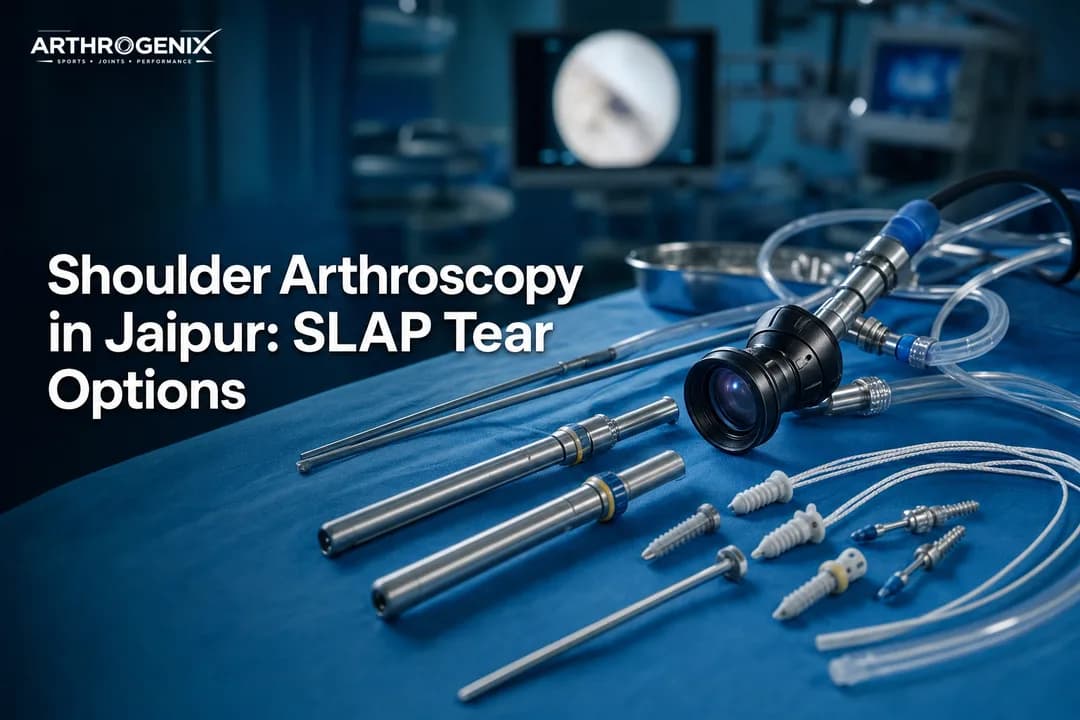
Arthroscopy uses a small camera and instruments through tiny portals. Therefore, it allows direct inspection of the labrum, biceps anchor, and cartilage surfaces. In addition, it helps the surgeon treat associated findings such as rotator cuff fraying or impingement.
In our day-to-day work at ArthroGenix, a pattern we repeatedly see is this: people push through pain for months, then lose strength and confidence. Once we identify the exact pain generator, outcomes often improve with a focused plan. Still, we never promise a “quick fix,” because tissue quality and rehab adherence change results.
Non-Surgical Treatment: When Rehab Makes Sense
First, we usually start with physiotherapy that restores scapular mechanics and rotator cuff endurance. Next, we adjust lifting technique and reduce provocative overhead volume. Meanwhile, anti-inflammatory strategies may help control pain flares under medical guidance.
A typical rehab plan targets posterior capsule tightness and biceps overload patterns. Therefore, the therapist often emphasizes thoracic mobility, external rotation strength, and gradual return to overhead loading. If pain reduces and function returns, surgery may not add value.
Surgical Treatment Choices During Arthroscopy
If symptoms persist despite appropriate rehab, arthroscopy allows tailored repair based on tear type and your age, sport, and biceps demands. Importantly, there is no single “best” procedure for everyone. Instead, your surgeon chooses the option that best matches your shoulder mechanics and goals.
- SLAP repair: anchors reattach the labrum to bone, often used in younger overhead athletes with clear instability patterns.
- Biceps tenodesis: the surgeon reattaches the biceps tendon outside the joint, which can reduce traction pain at the labrum.
- Debridement: the surgeon smooths frayed tissue when the tear is stable and symptoms fit irritation rather than detachment.
- Addressing combined issues: cuff repair, subacromial decompression, or capsular work when indicated.
Notably, many surgeons consider biceps tenodesis more reliable for certain adult patients with biceps-dominant pain. However, the best choice depends on your exam, tear pattern, and sport demands.
For deeper background on labral anatomy and SLAP classifications, you can review the NCBI Bookshelf overview of superior labrum anterior-posterior lesions. That reference also explains how lesion types vary and why treatment must match the pathology.
Recovery Timeline, Rehab, and Return to Sport
Recovery after SLAP treatment depends on what we do inside the joint. Therefore, “arthroscopy” alone does not define the timeline. A debridement may allow earlier motion, while a repair needs more protection for healing.
In general, patients use a sling for comfort and protection early on, especially after repair or tenodesis. Next, physiotherapy progresses from range of motion to strengthening and then sport-specific training. Importantly, a safe return to play depends on strength symmetry, pain response, and movement quality, not just weeks on a calendar.
The AAOS notes that SLAP tears commonly occur in throwing athletes and may require a period of rest and rehab before returning to sport, even after surgery. See the AAOS patient guide for a patient-friendly discussion of expectations and decisions.
However, results vary depending on tear type, tissue quality, and how consistently you follow rehab. In addition, work demands matter. A desk job return differs from a job that requires repetitive overhead lifting.
What Patients Often Get Wrong During Recovery
First, many people rush strengthening before they regain smooth motion. As a result, the shoulder compensates and pain returns. Second, some stop rehab when pain drops, yet endurance remains low. Consequently, symptoms recur once sport intensity rises.
Instead, we recommend objective milestones with your physiotherapist. For instance, you should regain controlled overhead movement without shrugging. Similarly, you should tolerate progressive loading without next-day spikes.
Choosing the Right Surgeon in Jaipur for SLAP Care
When you search for an orthopaedic surgeon in Jaipur or a shoulder surgeon Jaipur, look for someone who regularly treats sports injuries and arthroscopic shoulder problems. Importantly, SLAP decisions require nuance. A surgeon should explain why a specific procedure fits your anatomy and sport, and what the trade-offs are.
At ArthroGenix, Dr Abhishek Saxena focuses on evidence-based sports injury management, including arthroscopy for shoulder and knee conditions. If you want to explore options, you can start with the ArthroGenix sports orthopaedic clinic in Jaipur homepage and note the conditions treated. You can also review the practice approach at ArthroGenix before booking.
During a consultation, ask about the likely pain generator, what rehab can realistically achieve, and what surgery would change. Also, ask how the plan adapts if you have associated issues such as rotator cuff irritation. That conversation builds trust and reduces surprises.
If you take one message from this article, it is this: shoulder arthroscopy in Jaipur can be an excellent tool for SLAP tear care, yet it works best when the diagnosis is precise and rehab stays consistent. If you want a balanced opinion, consider an evaluation at ArthroGenix to review your scans, goals, and best-fit treatment path without pressure.