
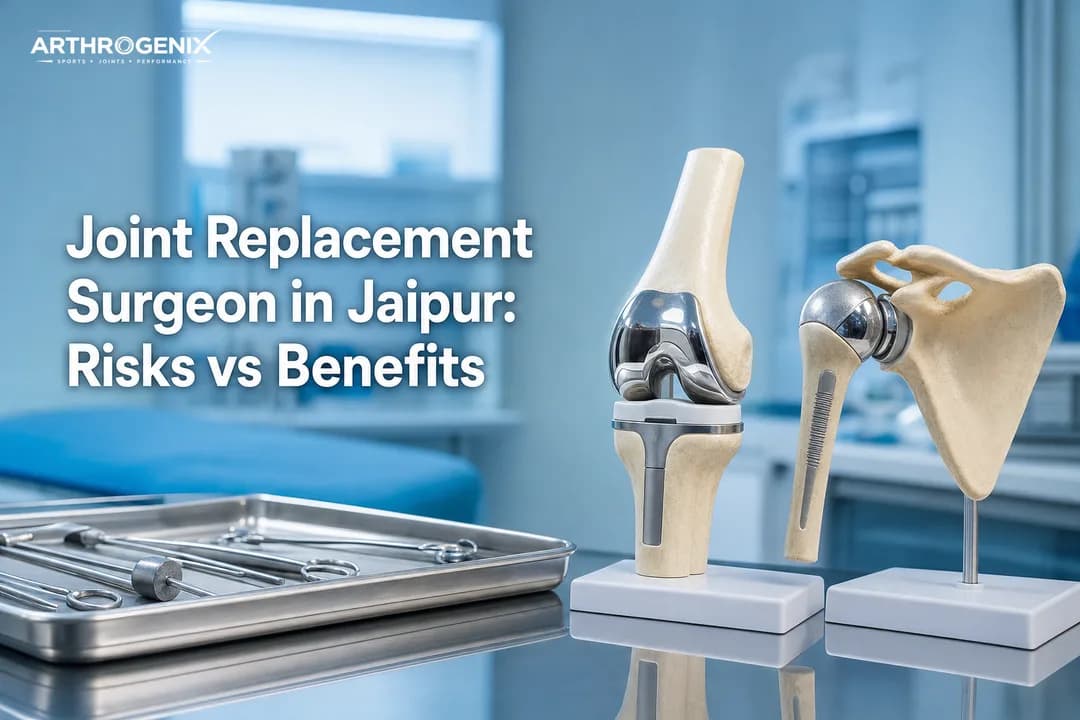
If you are weighing “Joint Replacement Surgeon in Jaipur: Risks vs Benefits,” you are already asking the right question. A sports orthopaedic surgeon can help you compare pain relief and mobility gains against real surgical risks. In this guide, you will learn when replacement makes sense, what complications to discuss, and how to choose a team for safer recovery.
Why Joint Replacement Becomes The Right Next Step
Most people do not start with surgery. First, they try activity changes, physiotherapy, weight management, and medicines. However, when cartilage loss becomes advanced, these steps may stop working.
In knee and shoulder arthritis, the joint surface wears down and triggers inflammation. As a result, you may feel pain at rest, night pain, and stiffness that limits daily tasks. At that point, replacement can shift from “optional” to “reasonable.”
Signs That Non-Surgical Care Is No Longer Enough
Several patterns signal that conservative care has reached its limit. For example, you might struggle with stairs, sit-to-stand, or dressing. Similarly, many people notice that pain returns quickly after short walks.
- Persistent pain despite supervised rehab and medication trials
- Functional loss like reduced walking distance or unstable knee
- Sleep disruption from night pain or position pain
- Progressive deformity such as bow-legs or knock-knees
- Imaging correlation where X-ray or MRI matches symptoms
Importantly, imaging alone should not decide surgery. Instead, your symptoms, goals, and overall health must guide the plan.
Sports Orthopaedic Surgeon View: Joint Replacement Trade-Offs
A sports orthopaedic surgeon looks at replacement as one option on a spectrum. Therefore, we also discuss joint preservation, arthroscopy when appropriate, and targeted injections. The goal is to pick the least invasive step that still restores function.
In our day-to-day work at ArthroGenix, we repeatedly see one pattern in Jaipur. People often wait until pain becomes constant and strength drops sharply. Consequently, rehab after surgery can feel harder than it needed to be. Earlier evaluation lets us build strength, correct gait, and plan home support before the operation.
Key Benefits Patients Commonly Seek
The main benefit is improved quality of life. In addition, many patients want independence, safer walking, and the ability to exercise again. When surgery matches the right indication, these goals become realistic.
For knee replacement, studies often report large improvements in pain and function. For example, an overview from the National Institute of Arthritis and Musculoskeletal and Skin Diseases (NIAMS) explains that knee replacement aims to reduce pain and help you return to everyday activities. Notably, NIAMS also highlights that recovery takes time and structured rehab.
For shoulder replacement, the benefit often shows up as easier overhead reach and less night pain. However, outcomes depend on cuff integrity, bone quality, and rehab consistency.
What “Successful” Really Means In Real Life
Success is not a perfect joint. Instead, it means a stable joint that lets you work, walk, and sleep with far less pain. Moreover, it means you can exercise safely without constant fear of flare-ups.
Joint Replacement Surgeon Jaipur: Risks You Must Discuss
Any joint replacement carries risks. Therefore, a good surgeon will talk about them clearly and without rushing. You should also expect a discussion about risk reduction steps before and after surgery.
Some risks are uncommon but serious. Others are more frequent yet manageable. The right plan balances them against how much arthritis limits your life.
Early And Late Risks To Know
First, there are immediate surgical risks such as bleeding, anesthesia issues, and wound problems. Next, there are joint-specific risks like stiffness, instability, or nerve irritation. Finally, there are longer-term concerns such as implant wear or loosening.
Infection is one of the most important topics. Importantly, the CDC guidance on surgical site infection explains how prevention relies on factors such as sterile technique and patient health. Because of this, your surgeon may recommend optimizing diabetes control, nutrition, and skin condition before surgery.
Blood clots can also occur after lower-limb surgery. Consequently, surgeons use early mobilization, compression, and medicines when indicated. The exact plan depends on your risk profile and other medications.
Who Has Higher Risk And What You Can Control
Risk is not the same for everyone. For instance, smoking, uncontrolled diabetes, obesity, anemia, and poor muscle strength can raise complication rates. However, many of these factors can improve with a pre-surgery “prehab” program.
Furthermore, medication review matters. Blood thinners, steroids, and some supplements can affect bleeding and healing. Therefore, always share your full medication list, including over-the-counter pills.
How To Choose The Best-Fit Surgeon And Plan In Jaipur
The best decision comes from a precise diagnosis and a shared plan. So, focus on the process, not just the implant brand or hospital size. You want a team that can explain options in plain language.
At ArthroGenix, Dr Abhishek Saxena’s background in arthroscopy, ligament reconstruction, and joint preservation supports a “right procedure for the right patient” approach. In many cases, we first confirm whether pain comes from arthritis, a meniscus tear, a cartilage injury, or a ligament issue. As a result, some patients avoid unnecessary replacement and do better with targeted care.
Questions Worth Asking In Your Consultation
Bring your goals to the visit. For example, you may want to return to long walks, manage stairs, or get back to recreational sports. Then ask questions that reveal the surgeon’s planning and follow-through.
- Which joint surfaces are damaged, and how does that match my symptoms?
- What non-surgical and joint preservation options still make sense for me?
- What implant type fits my anatomy and activity level, and why?
- How will you reduce infection and clot risk in my case?
- What does my rehab timeline look like, week by week?
Additionally, ask who coordinates physiotherapy and how follow-ups work. Clear communication often predicts smoother recovery.
If you want to explore options with a Jaipur sports orthopaedic team, you can start at ArthroGenix. You can also review the clinic’s approach to diagnosis and return-to-activity planning through this sports orthopaedic and joint care practice in Jaipur.
Recovery, Rehab, And Long-Term Joint Protection
Recovery does not end after discharge. Instead, it continues through structured physiotherapy and progressive strengthening. Therefore, planning rehab is as important as planning surgery.
Most people improve step by step. However, the pace varies with age, muscle condition, pain sensitivity, and home support. Because of this, you should treat timelines as ranges, not promises.
For knee replacement, early priorities often include swelling control, safe walking, and restoring knee extension. Next, strength and endurance build over weeks. For shoulder replacement, early priorities often include protecting soft tissues and regaining functional range under guidance.
Importantly, the American Academy of Orthopaedic Surgeons explains core expectations for joint replacement and rehabilitation in its patient resources. You can read their overview at AAOS OrthoInfo on total knee replacement. Notably, AAOS emphasizes adherence to rehab and follow-up care for best function.
Finally, long-term protection matters. Maintain healthy body weight, build leg and core strength, and choose low-impact conditioning. Similarly, address new pain early so you do not compensate and strain other joints.
To sum up, “Joint Replacement Surgeon in Jaipur: Risks vs Benefits” is best answered with a personalised evaluation, not a one-size rule. A sports orthopaedic surgeon can help you weigh realistic benefits against infection, clot, stiffness, and implant-related risks. If you want a balanced opinion, ArthroGenix shares evidence-based options and careful rehab planning, without pressure to rush into surgery.