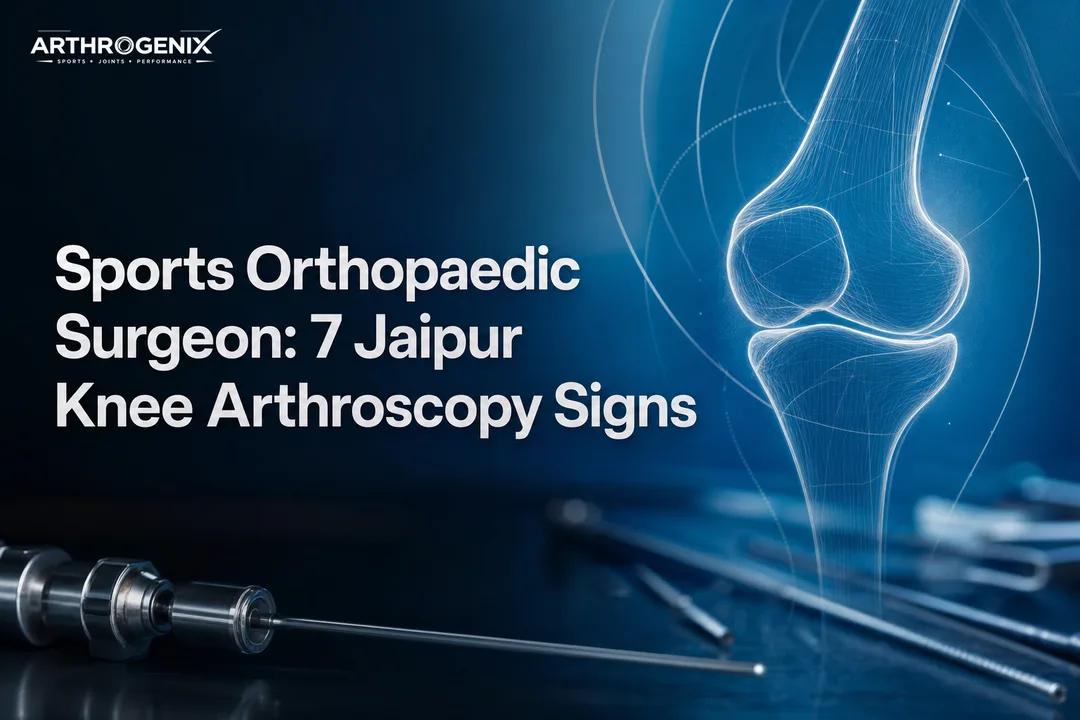
At ArthroGenix Jaipur, our sports orthopaedic surgeon sees the same warning patterns every week. In this guide — Sports Orthopaedic Surgeon: 7 Jaipur Knee Arthroscopy Signs — you will learn when minimally invasive knee arthroscopy is likely the right next step and how to move forward with confidence.
Do these signs point to knee arthroscopy?
Not every sore knee needs surgery. However, certain symptoms suggest a mechanical problem inside the joint that simple rest will not fix. In our clinic work with athletes, active professionals, and seniors, we often see seven clear indicators that nudge us toward arthroscopy after a proper trial of conservative care.
1) Painful catching or locking: If your knee suddenly locks or you feel a sharp catch during bending or twisting, a torn meniscus or loose cartilage fragment may be blocking smooth motion.
2) Recurrent swelling after activity: Repeat effusions after runs, long walks, or stairs can mean tissue is getting irritated inside the joint every time you load it.
3) Persistent pain despite focused rehab: If targeted physiotherapy, activity modification, and anti-inflammatories fail to restore function over several weeks, the pain may have a mechanical driver.
4) Instability after a pivot or twist: A sense of the knee “giving way,” especially after a sports twist, raises concern for ligament injury or an unstable meniscal tear.
5) Localised, reproducible clicking: Clicking that is painful and occurs at a certain angle, rather than harmless crepitus, often points to meniscus or cartilage flaps.
6) Loose body sensations: A feeling that something is “floating” or moving inside the knee can be a cartilage or bone fragment that needs removal.
7) Imaging-backed structural injury: When clinical findings match MRI evidence of an unstable meniscus tear, cartilage flap, or loose body, arthroscopy can address the root cause directly.
7 red flags you shouldn’t ignore
In the exam room, we test for these patterns methodically. For example, joint-line tenderness with a positive McMurray test strengthens the suspicion of a meniscus tear. Likewise, a pivot-shift or Lachman test suggests ACL laxity. Importantly, we weigh your goals, age, and activity level alongside imaging, because findings only matter when they map to your function.
According to AAOS OrthoInfo guidance on arthroscopy, this minimally invasive approach uses small portals and a camera to diagnose and treat many intra-articular problems. Therefore, if your symptoms are mechanical and persistent, arthroscopy often provides both clarity and correction in the same sitting.
When to see a sports orthopaedic surgeon in Jaipur
Timing matters. First, give quality non-operative care an honest try with activity modification, structured physiotherapy, ice, and evidence-based injections when indicated. If your knee still catches, swells, or gives way, it is time to seek a focused evaluation. As a rule, pain that blocks your work, training, or sleep despite proper rehab deserves expert attention.
Importantly, your goals shape the decision. A marathoner with a locking knee faces different demands than a desk professional who struggles with stairs. Because of this, we align recommendations with your season, schedule, and long-term joint health. If you need rapid clarity on the path forward, schedule a careful assessment at ArthroGenix.
What a sports orthopaedic surgeon evaluates
At your consult, we start with a detailed history. We map out the exact motion that triggers pain or locking. Next, we examine gait, swelling, alignment, range of motion, and ligament stability. We perform specific tests for the meniscus, cartilage, and cruciate ligaments. Then, we review imaging if available, or order targeted views and an MRI when clinical signs justify it.
We explain trade-offs clearly. For instance, a stable, small meniscus tear may respond to rehab, while an unstable flap that locks the joint usually benefits from arthroscopy. Moreover, if you have combined issues, we outline staged versus single-sitting solutions, always keeping rehab and return-to-activity timelines realistic.
Sports injury specialist or arthroscopy surgeon?
Many patients ask whom to see first. A sports injury specialist with arthroscopy expertise can evaluate, image, and operate when needed, which streamlines care. Conversely, if you begin with general care and stall out, request a referral for a knee-focused assessment. Either path is fine; your goal is a diagnosis-led plan that matches your life, not one-size-fits-all advice.
How minimally invasive arthroscopy helps you heal
During knee arthroscopy, we create two or three small portals and insert a pencil-sized camera to view the joint. We then pass slim instruments to trim, repair, or remove the damaged tissue. As MedlinePlus explains, arthroscopy uses small incisions and specialized tools to diagnose and treat joint problems, often reducing soft-tissue trauma compared with open approaches.
Because the incisions are small and muscle disruption is minimal, recovery can be faster than with open surgery for similar problems. However, healing time depends on what we do inside the knee. A partial meniscectomy typically allows earlier weight bearing, while a meniscus repair or ligament procedure needs more protection and a staged rehab plan.
In our operating room, we prioritise tissue preservation. When possible, we repair the meniscus to protect long-term cartilage health. When repair is not feasible, we contour only the unstable portion to restore smooth motion. For cartilage flaps or loose bodies, we remove the culprit and address the underlying surface as indicated.
Risks, recovery, and rehab basics
Every procedure has risks. The most common include temporary swelling, stiffness, or discomfort. Infection and clots are rare but important to prevent and recognise early. We discuss these upfront and build a plan that reduces risk and supports safe progress. Furthermore, we coordinate closely with your physiotherapist so you gain strength and confidence week by week.
Day 1–7: early mobility goals
Right after surgery, we focus on swelling control, gentle range of motion, and a normal walking pattern as allowed by your specific procedure. Then we add progressive strengthening, balance work, and sport-specific drills as healing milestones are met. Finally, we clear you for return to sport when your strength, control, and confidence meet objective criteria.
Use this simple checklist to stay on track:
- Ice and elevate as directed to limit swelling.
- Follow your weight-bearing and brace instructions exactly.
- Work on gentle extension and flexion under guidance.
- Do daily quad activation and straight-leg raises if cleared.
- Report new calf pain, fever, or severe redness immediately.
According to AAOS OrthoInfo, most patients resume desk work soon after simple arthroscopy, while higher-impact sports require a longer, criteria-based return. Therefore, your timeline is individual, and your plan should flex with your response to rehab rather than fixed dates on a calendar.
Your next steps with ArthroGenix Jaipur
If your symptoms match the signs above, do not ignore them. Instead, get a precise diagnosis and a plan that respects your goals. We begin with the least invasive path that can work. If arthroscopy is the best option, we explain the steps, the rehabilitation roadmap, and the likely trade-offs in plain language. Choose a sports orthopaedic surgeon who treats you like a partner, not a case number.
At ArthroGenix, led by Dr. Abhishek Saxena, we look after athletes, active adults, and seniors with the same attention to detail. In our experience, a clear exam, matched imaging, and a personalised rehab plan produce the best outcomes. For an expert review of your knee and a calm, structured plan, contact Jaipur’s arthroscopy-focused team at ArthroGenix. Results vary based on your specific injury, overall health, and commitment to rehab, so we set expectations together.
Ready to move without fear of catching, swelling, or giving way? Book a thoughtful evaluation, ask every question you have, and decide at your pace. If surgery is appropriate, speaking with a sports orthopaedic surgeon at ArthroGenix will help you choose the safest and most effective route back to activity.