
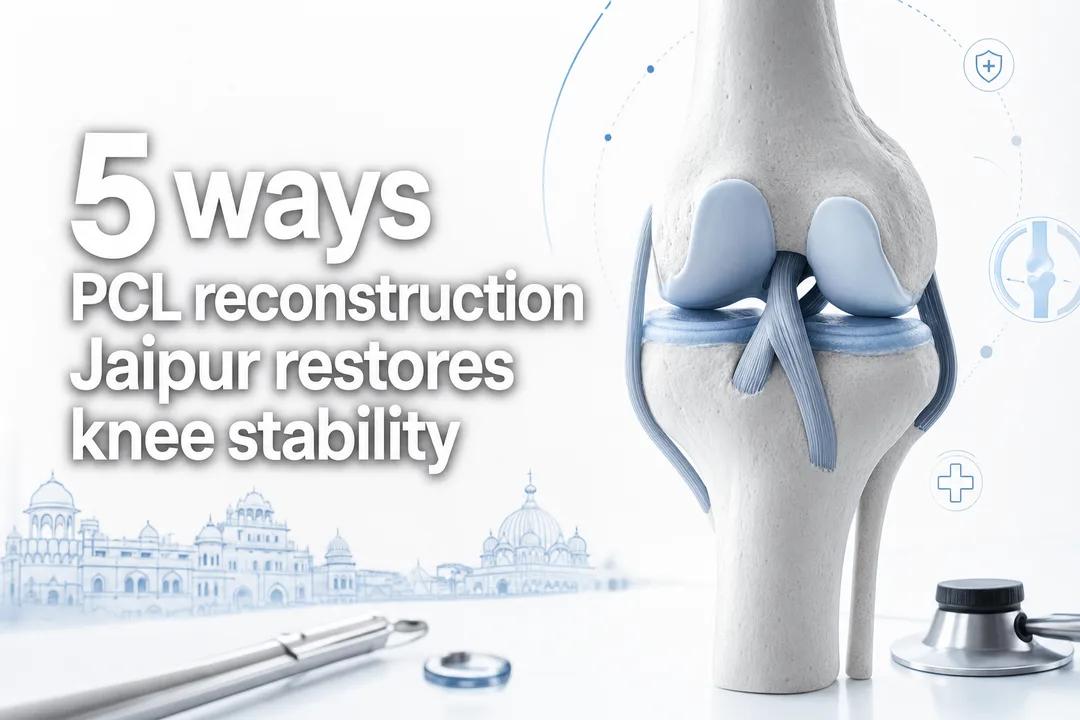
In this guide—5 ways PCL reconstruction Jaipur restores knee stability—we explain how evaluation, surgical technique, and rehab come together to stop posterior sag and give you reliable movement again. If you are weighing options with a sports orthopaedic surgeon, you will learn what matters before, during, and after surgery to protect your knee and return to activity.
Why knee stability fails after a PCL tear
The posterior cruciate ligament prevents the shinbone from sliding backward under the thighbone. When it tears, the tibia rests too far back. As a result, your knee can feel loose during stairs, squats, or braking while running. Over time, that abnormal glide can stress the meniscus and the cartilage on the medial femoral condyle and tibial plateau.
From our experience treating athletes and active professionals in Jaipur, we see two patterns. First, low-grade or isolated tears may feel stable enough with bracing and targeted rehab. Second, high-grade or combined injuries with the ACL, posterolateral corner, or meniscus often keep the knee unstable without surgical reconstruction. Therefore, your exam should always include posterior drawer testing, dial tests, and gait assessment.
Authoritative guidance recognizes this decision-making. For instance, the American Academy of Orthopaedic Surgeons notes that many isolated PCL injuries improve with non-operative care, while severe or combined tears may need surgery to restore function (AAOS OrthoInfo overview of PCL injuries). Likewise, a clinical review on the NCBI Bookshelf details how persistent instability and multi-ligament trauma are key indications for reconstruction (StatPearls: Posterior Cruciate Ligament Knee Injuries). Additionally, MedlinePlus outlines rehab principles and injury mechanisms that inform the plan of care (MedlinePlus: Knee ligament injuries).
5 ways PCL reconstruction Jaipur restores knee stability
Reconstruction aims to recreate native ligament anatomy and correct posterior tibial translation. Below are five levers that, when done well, help patients feel stable and move with confidence again.
- Anatomic tunnel placement that restores the PCL’s footprint
- Graft selection and fixation that limit posterior sag
- Addressing associated structures to balance forces
- Precision arthroscopy to correct subtle drivers of pain
- Structured, protection-first rehabilitation
Anatomic tunnel placement for true knee mechanics
Surgeons create tunnels in the femur and tibia to anchor the graft on the PCL’s anatomic footprints. When those tunnels match native attachment sites, the graft checks posterior glide throughout the arc of motion. Consequently, patients report less giving way during daily tasks and sport-specific moves.
Single-bundle vs double-bundle decisions
Both techniques aim to restore function. Single-bundle reconstructs the primary restraint and simplifies the construct. Double-bundle attempts to reproduce both anterolateral and posteromedial fiber sets for finer control. Importantly, the choice depends on knee size, associated injuries, and surgeon expertise. In our clinic, we discuss trade-offs openly so the plan fits your goals.
Fluoroscopic guidance and arthroscopic visualization help confirm tunnel placement. Moreover, careful tunnel orientation reduces graft impingement and preserves bone stock for robust fixation. In practice, these technical details translate into smoother flexion and a firmer end point on posterior drawer testing.
Graft choice and fixation minimise posterior sag
Your graft is the new ligament. Common options include autograft (patient’s own hamstrings, quadriceps, or patellar tendon) or allograft (donor tissue). Each has pros and cons. For example, autograft offers biologic vitality and secure fixation, while allograft avoids donor-site soreness and speeds early rehab. However, activity level, tissue quality, and timing after injury all matter.
Equally critical, fixation must resist constant posterior shear. Therefore, surgeons use suspensory buttons, interference screws, or hybrid constructs to secure the graft while it incorporates. When fixation holds and tunnels are anatomic, the graft functions as a checkrein against unwanted motion.
When is PCL reconstruction Jaipur recommended?
We recommend surgery when posterior sag persists despite focused rehab, when you have a high-grade tear, or when you carry a multi-ligament injury pattern. Notably, continued instability can overload cartilage and meniscus, which raises long-term wear risk. If you want to return to cutting sports, manual work, or demanding fitness, stable mechanics support safer performance.
Patients choosing PCL reconstruction Jaipur often ask about recovery timelines. Typically, you walk with support early, yet heavy hamstring loading stays limited in the first weeks. Additionally, we tailor timelines to your tissue quality, graft type, and sport. Because of this, you get a plan that protects the graft while building capacity for strong return-to-play testing.
Rehab milestones after PCL surgery in Jaipur
Reconstruction is half the story. Thoughtful rehab finishes the job by guiding graft maturation and retraining neuromuscular control. As a result, disciplined progressions reduce setbacks and boost long-term satisfaction.
Phased loading protects the graft
In the protection phase, we prioritise full extension, quiet swelling, and quad activation. For example, heel props, patellar mobilisations, and straight-leg raises build a solid base without stressing the posterior tibia. Meanwhile, we limit deep flexion under load because that increases posterior translation.
Next, the strength phase layers in closed-chain patterns like split squats, step-ups, and monitored cycling. Importantly, we coach alignment and pace, since quality reps rebuild confidence and knee symmetry. Then, the power and plyometric phase reintroduces running progressions, directional changes, and controlled landings. Finally, sport integration confirms that your knee tolerates volume, speed, and chaos.
Objective criteria matter. Therefore, we track limb symmetry indexes, hop tests, and strength ratios before we clear you for higher demands. In fact, athletes who pass objective benchmarks tend to report smoother returns and fewer relapses. We apply the same principles to active adults who need reliable knees for work and life.
How ArthroGenix guides safer comebacks
At ArthroGenix in Jaipur, Dr. Abhishek Saxena and our team align diagnosis, arthroscopy, and rehab into one plan. We start by mapping your injury: clinical testing, motion analysis, and targeted imaging. Then we discuss options honestly, including non-operative pathways and timelines. Because every knee is unique, you get a plan that respects your sport, job, and goals.
When surgery is indicated, we use advanced arthroscopy to address more than the ligament. For instance, we smooth unstable cartilage edges, assess meniscal root integrity, and release adhesions that limit glide. Furthermore, we set graft tension with your knee in ranges that protect posterior stability during daily life. This is where real-world experience matters most.
Our clinicians coordinate rehab with clear guardrails and communication. As a result, you always know the next milestone and the criteria to earn it. If you are researching options, explore how our approach at ArthroGenix blends surgical precision with high-performance rehab to speed safe, confident returns.
We also support shoulders, ACL and meniscus repairs, and joint preservation strategies for complex knees. Additionally, we counsel on load management, footwear, and strength plans that protect your investment in surgery. For broader context, our Jaipur-based team delivers comprehensive sports injury management under one roof.
Every patient progresses at a different pace. Healing depends on tear grade, tissue quality, graft choice, and diligence with therapy. Therefore, we never promise instant results. However, with clear criteria, steady effort, and good sleep and nutrition, most people report meaningful stability gains and lower pain across the first few months.
If you need guidance, our team is ready to help you decide if surgery fits your goals and to map a practical path back to the activities you love. Learn more about our evidence-based care at sports orthopaedic care in Jaipur.
In short, 5 ways PCL reconstruction Jaipur restores knee stability come down to precise anatomy, strong fixation, complete arthroscopic care, criteria-driven rehab, and an honest partnership with your clinical team. If you are weighing PCL reconstruction Jaipur, we are here to answer questions and support you from first consult to full return.