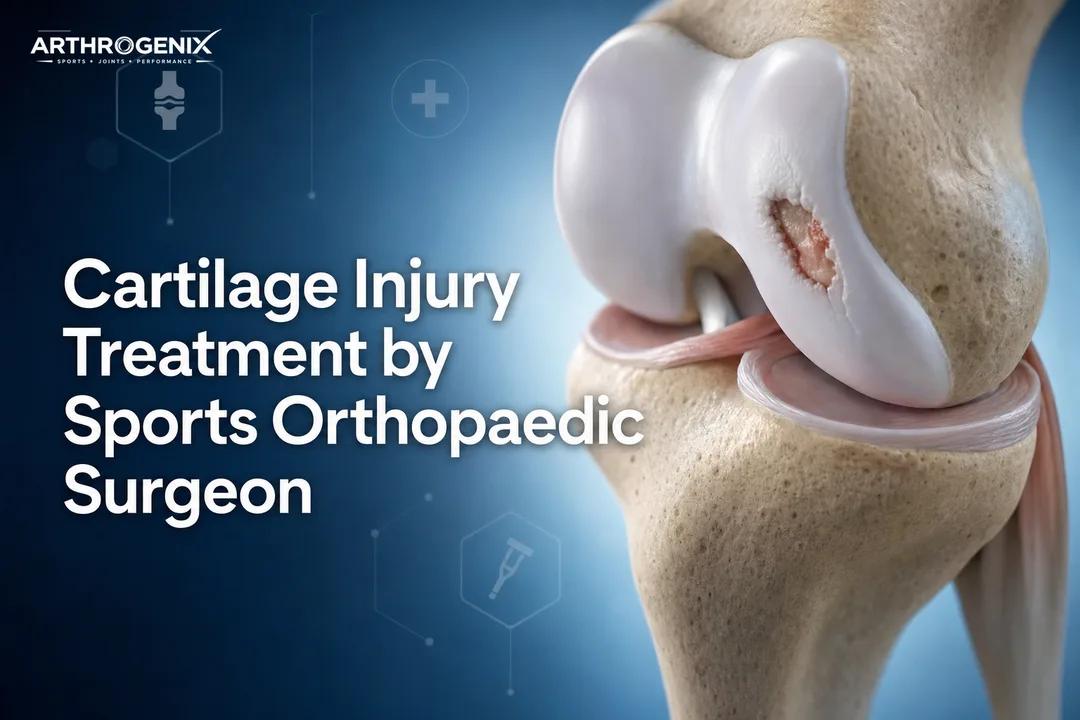
If knee pain, catching, or swelling is slowing you down, start with Cartilage Injury Treatment by Sports Orthopaedic Surgeon to understand your options. At ArthroGenix in Jaipur, we help athletes and active people get a clear diagnosis and a safe plan to return to sport with the guidance of a sports orthopaedic surgeon who treats cartilage damage every week.
What cartilage injury means for your knee or shoulder
Articular cartilage is the smooth, white cushion that lets your joints glide without friction. It absorbs shock and protects the underlying bone. Because cartilage lacks a direct blood supply, it heals slowly after injury. Consequently, untreated defects can enlarge and lead to stiffness, swelling, or early arthritis.
In sports, we often see focal cartilage defects from twisting injuries, sudden impact, or a direct blow. For knees, pivoting sports like football, kabaddi, and basketball raise risk. Shoulder cartilage can suffer with instability or repeated overhead load. Notably, research shows cartilage lesions appear frequently during knee arthroscopy. A classic multi-centre series found chondral damage in 63% of 31,516 knees examined arthroscopically (Curl et al., Arthroscopy).
In clinic, we also see combined injuries. For example, a meniscus tear or ACL rupture can expose cartilage to abnormal stress. Therefore, early assessment and joint-preserving treatment matter. For a helpful overview of restoration techniques, the American Academy of Orthopaedic Surgeons explains current approaches to articular cartilage care (AAOS OrthoInfo).
Diagnosis and evaluation in Jaipur: getting it right
Accurate diagnosis guides the right treatment and timeline. We begin with a detailed history: when pain began, movement patterns that trigger it, swelling after activity, and any locking or giving way. Then we perform a targeted exam to localize tenderness, assess alignment, check ligament stability, and test joint tracking.
Next, we use imaging to confirm size, depth, and location of the defect. X-rays show bone and alignment. Weight-bearing knee X-rays reveal joint space and load distribution. MRI maps cartilage quality, bone bruising, meniscus health, and hidden ligament issues. Because cartilage is avascular and has limited intrinsic repair capacity, imaging helps us prioritize joint preservation (StatPearls: Articular Cartilage Injury).
In our Jaipur practice, we often see athletes with small flaps on the femoral condyle after an ACL sprain. With experience, we’ve learned to correlate subtle exam findings with MRI signs of early cartilage wear. As a result, we can start protection and targeted loading before damage grows.
Choosing the right sports injury specialist in Jaipur
Experience with arthroscopy and joint preservation matters. Look for a team that treats athletes regularly, plans rehab early, and measures progress. At ArthroGenix, Dr. Abhishek Saxena combines advanced arthroscopy with evidence-based rehab so you return to sport safely, not just quickly. Importantly, you should feel heard, understand your MRI, and see a structured plan before starting care.
Treatments a sports orthopaedic surgeon uses
There is no one-size-fits-all plan for cartilage. We match treatment to the lesion’s size, depth, location, alignment, sport demands, and your goals. Small, stable defects may respond to non-surgical care. Larger or unstable lesions may need arthroscopic repair or restoration.
Non-surgical options and joint preservation
First, we calm the joint. Short-term activity modification, anti-inflammatory strategies, and precise physiotherapy reduce swelling and protect the area. Your program may include hip and core strength, neuromuscular control, and kinetic chain correction to offload the injured zone. Furthermore, bracing or taping can guide patellar tracking or reduce painful shear.
Injections can help in selected cases. Hyaluronic acid may improve joint lubrication for mild osteoarthritic change. Platelet-rich plasma is an option for symptom control in certain patterns, though protocols vary and results differ across patients. We discuss trade-offs transparently and avoid hype. Our goal is to manage pain, preserve function, and create a safe platform for either return to play or a later restorative procedure.
Arthroscopy and cartilage repair procedures
When symptoms persist or the defect is unstable, we often recommend keyhole surgery. Arthroscopy allows precise diagnosis and targeted repair through small incisions. We can remove loose bodies, stabilize cartilage flaps, and perform restoration procedures based on defect size and location.
Common strategies include microfracture for small contained lesions, osteochondral autograft transfer (OATS) for plug-like defects, or osteochondral allograft for larger areas. For select patients, cell-based options such as matrix-assisted chondrocyte implantation (MACI) help restore surface quality. If malalignment overloads the compartment, we may pair cartilage work with an alignment correction to share load more evenly. We always personalize the plan to your sport, schedule, and joint mechanics.
Microfracture vs. OATS: how we decide
Microfracture suits small, contained defects and relies on marrow stimulation to form a fibrocartilage fill. It is cost-effective and minimally invasive. However, durability can vary with high-impact or pivoting sports. OATS transfers a patient’s own cartilage and bone to the defect. It provides hyaline cartilage at the surface and can handle higher loads sooner, but graft size is limited, and donor site care is essential. We discuss these trade-offs in detail so you choose confidently.
When combined injuries exist, we address them together. For example, meniscus repair supports long-term cartilage health. Similarly, ACL reconstruction can restore stability and reduce abnormal shear on cartilage. As always, we prioritize tissue preservation and reliable function for your sport.
Recovery, rehab, and return to sport
Rehab starts before surgery with prehab to build strength and motion. After surgery, we follow a phase-based plan. Timelines depend on the procedure, lesion size, and your response to loading. Importantly, we test readiness with objective criteria, not the calendar alone.
Timelines, milestones, and safe progress
Every plan is individualized, but many athletes follow these checkpoints:
- Early phase: swelling control, gentle motion, and quad activation to protect the repair.
- Loading phase: progressive weight-bearing and closed-chain work to restore strength without shear.
- Control phase: neuromuscular and balance drills that steady knee or shoulder tracking under load.
- Power phase: plyometrics and resisted patterns matched to your sport demands.
- Return-to-sport phase: on-field drills, change of direction, and contact prep after objective tests.
We use strength ratios, hop tests, and movement quality screens to reduce re-injury risk. Moreover, we plan deload weeks and monitor response to spikes in training. Therefore, your return is progressive, confident, and data-informed.
When to see a sports orthopaedic surgeon in Jaipur
Consider an expert review if pain lingers beyond a few weeks, especially with swelling after activity. Mechanical symptoms such as catching or locking suggest unstable tissue that merits evaluation. In addition, recurring effusions, difficulty trusting the joint, or pain with stairs and squats point to focal damage that needs a clear plan.
If you had a twist injury and now struggle with deep joint pain, do not wait. Early protection and targeted loading may prevent lesion growth. When we see athletes soon after injury, we often preserve tissue, avoid bigger surgery, and speed a safer return to your sport.
Notably, choosing a center that integrates diagnosis, arthroscopy, and rehab saves time and reduces confusion. You can start that journey with our Jaipur sports orthopaedic team and get a tailored care map in one visit.
Why cartilage care must be individualized
Two athletes with similar MRI scans can feel very different on the field. Factors such as alignment, training load, neuromuscular control, and sport-specific forces change the plan. Because of this, we build your program around what you do, how you move, and what your season demands.
We also speak clearly about limitations. Cartilage repair aims to reduce pain and improve function, but outcomes vary with defect size, location, and adherence to rehab. Importantly, we avoid making guarantees. Instead, we guide you with transparent options and realistic timelines.
At ArthroGenix, we bring daily, on-the-ground experience treating cartilage injuries in athletes and active adults across Jaipur. We match modern arthroscopy with structured rehab because that combination protects repairs and restores confidence. For general principles of cartilage restoration, see the AAOS overview linked above. For background on healing limits, StatPearls provides a concise review.
In summary, a precise diagnosis, a joint-preserving mindset, and a measured return-to-sport plan drive success. If you feel stuck with pain, swelling, or locking, book a consult. We will explain your scans, outline choices, and help you move forward without pressure. When you are ready, our team can connect you with a sports orthopaedic surgeon to plan the next step.