
Understanding Ligament Reconstruction
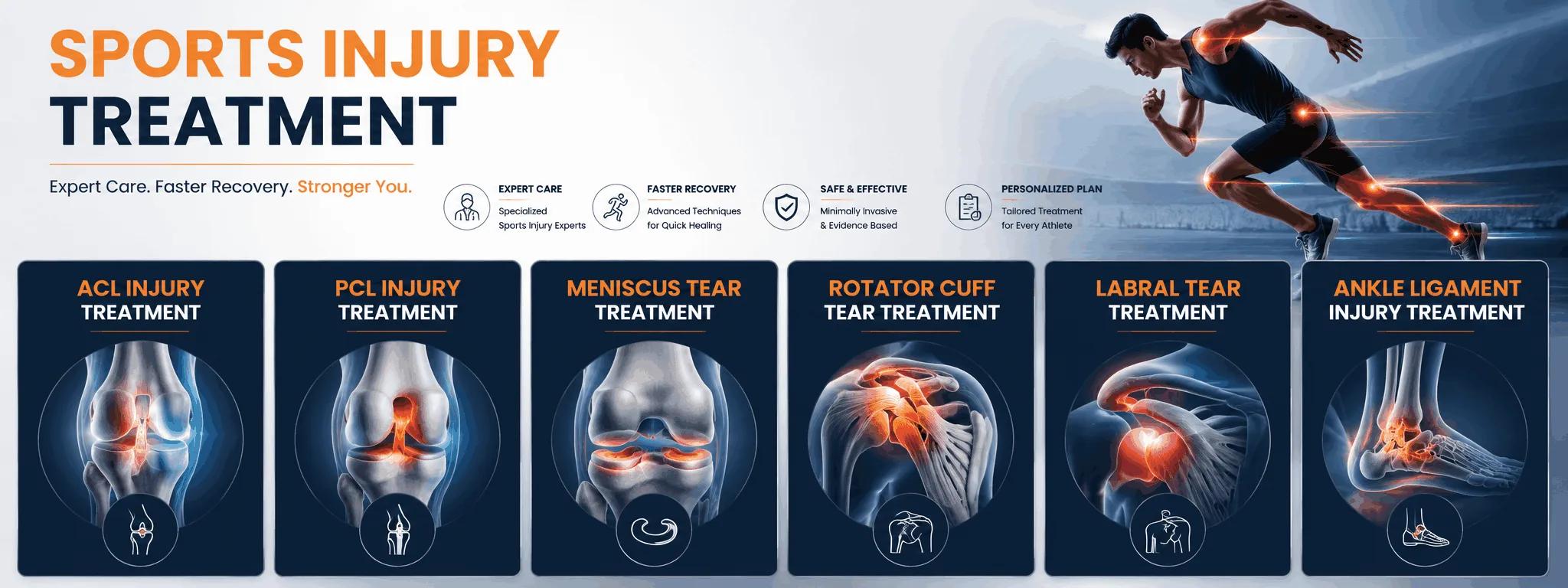
The knee is stabilised by four main ligaments. When one or more are torn beyond healing — as in ACL, PCL or multi-ligament injuries — reconstruction rebuilds them with grafts using arthroscopic techniques, restoring the stability needed for sport and demanding activity.
Each reconstruction is planned around the specific injury pattern, with graft choice and fixation tailored to you, and is paired with a structured rehabilitation programme that returns you safely and confidently to activity.
Key benefits
- Restores stability so the knee no longer gives way
- Protects the cartilage and meniscus from further damage
- Arthroscopic technique with tailored, evidence-based rehab
When Ligament Reconstruction is recommended
How the procedure is performed
Assessment
The injured ligaments and any associated damage are confirmed arthroscopically and on imaging.
Graft preparation
A suitable graft is harvested and sized for reconstruction.
Reconstruction
Bone tunnels are placed accurately and the graft fixed to restore natural stability.
Verification
Knee stability is checked before closure and a rehabilitation plan is set.
Preparation & prerequisites
- A detailed clinical assessment and review of your scans (X-ray / MRI) to confirm the diagnosis and plan the surgery precisely.
- Routine pre-operative blood tests, an ECG if needed, and a fitness-for-anaesthesia check by the anaesthetist.
- Stopping blood-thinning medication (such as aspirin or clopidogrel) only if advised, and disclosing every medicine and supplement you take.
- Fasting for around 6 hours before surgery, and arranging a responsible adult to drive you home and stay with you the first night.
- Preparing your home for recovery — ice packs, loose clothing, and a clear path free of trip hazards.
What recovery looks like
Weeks 0–6
Protect the graft, settle swelling and restore movement and muscle activation.
Weeks 6–16
Progressive strengthening and control work rebuild the knee.
Months 4–9
Sport-specific rehabilitation leads to a tested, staged return.
How to recover well
- Follow the RICE principle early — rest, ice 15–20 minutes several times a day, gentle compression and elevation to control swelling.
- Take pain relief as prescribed rather than waiting for pain to build, and keep the wound clean and dry.
- Attend every physiotherapy session and do your home exercises — rehabilitation is as important as the surgery itself.
- Progress activity gradually and don't return to sport until you're formally cleared, to protect the repair.
- Watch for warning signs — spreading redness, fever, calf pain or increasing swelling — and call us if they appear.
Risks, safety & outcomes
In experienced hands this is a very safe procedure, and serious problems are uncommon. Every step is taken to minimise risk — but being fully informed is part of good care. Possible risks include:
- Graft re-injury if returning to sport before rehab targets are met
- Stiffness, reduced by early guided movement
- The usual small arthroscopic surgical risks
Results & outlook
Reconstruction combined with diligent rehabilitation restores stability and confidence for most patients, enabling a return to sport and protecting the knee from the further damage that instability causes.
Frequently asked questions
The ACL and PCL are most common, and complex multi-ligament injuries can also be reconstructed in a planned, staged way.