
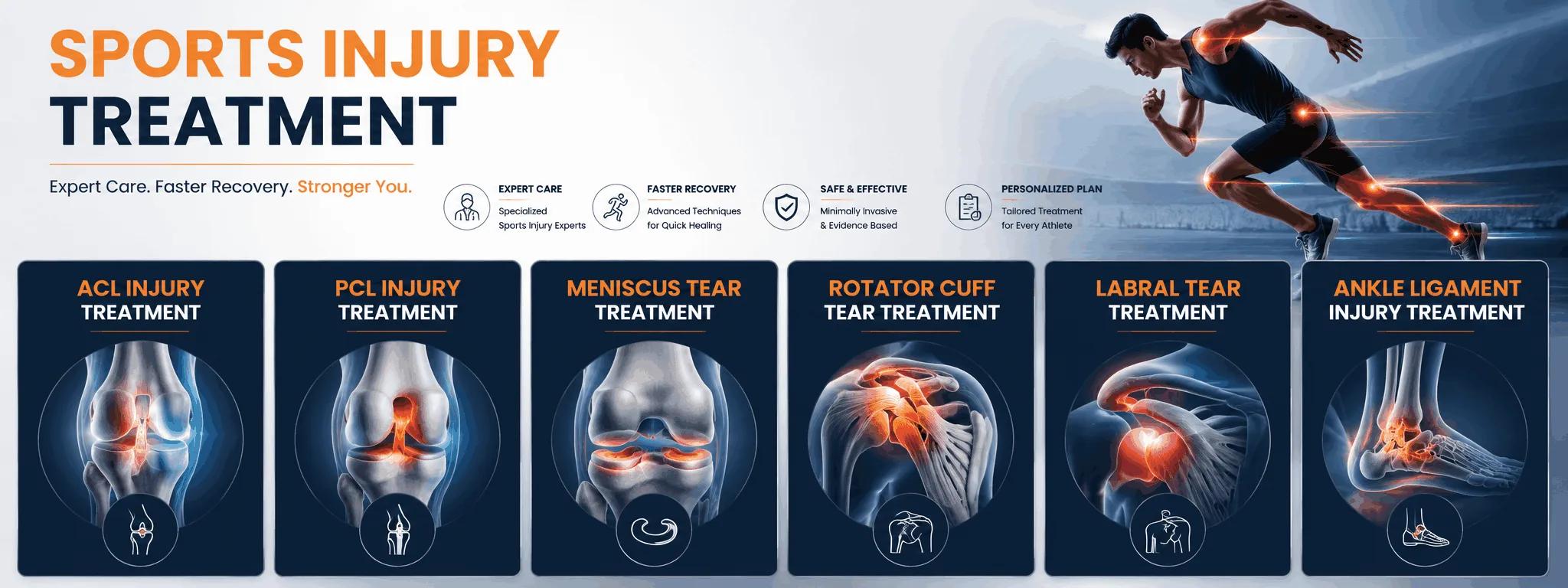
Understanding ACL Reconstruction
The anterior cruciate ligament (ACL) is a key stabiliser in the centre of the knee that stops the shin bone sliding forward and controls twisting movements. When it tears it does not heal back together, so an unstable knee is rebuilt with a new ligament — a graft — in a keyhole operation called ACL reconstruction.
The graft is usually taken from your own hamstring or patellar tendon, positioned precisely at the ligament's natural attachment points, and fixed under the right tension. Combined with a structured return-to-play rehabilitation programme, it is the gold-standard treatment for restoring stability in athletes and active people.
Key benefits
- Restores stability so the knee no longer gives way
- Protects the meniscus and cartilage from further damage
- Enables a confident return to pivoting and contact sport
- Keyhole technique with a structured, evidence-based recovery
When ACL Reconstruction is recommended
How the procedure is performed
Graft harvest
A graft is taken from your own hamstring or patellar tendon and carefully prepared to the correct size and strength.
Tunnel placement
Using the arthroscope, precise tunnels are drilled in the thigh and shin bones at the ligament's natural anatomic points.
Graft fixation
The new ligament is passed through the tunnels and fixed securely under the correct tension with dedicated fixation devices.
Verification
Knee stability and full range of motion are checked arthroscopically before the small incisions are closed.
Preparation & prerequisites
- A detailed clinical assessment and review of your scans (X-ray / MRI) to confirm the diagnosis and plan the surgery precisely.
- Routine pre-operative blood tests, an ECG if needed, and a fitness-for-anaesthesia check by the anaesthetist.
- Stopping blood-thinning medication (such as aspirin or clopidogrel) only if advised, and disclosing every medicine and supplement you take.
- Fasting for around 6 hours before surgery, and arranging a responsible adult to drive you home and stay with you the first night.
- Preparing your home for recovery — ice packs, loose clothing, and a clear path free of trip hazards.
What recovery looks like
Weeks 0–2
Focus on settling swelling, regaining full straightening of the knee and switching the quadriceps back on.
Weeks 2–12
Progressive weight-bearing, range of motion and strengthening under close physiotherapy supervision.
Months 3–6
Jogging, agility and sport-specific drills are introduced as strength and control return.
Months 6–9
Return to competitive sport once objective strength, hop and control tests are passed — not just by the calendar.
How to recover well
- Follow the RICE principle early — rest, ice 15–20 minutes several times a day, gentle compression and elevation to control swelling.
- Take pain relief as prescribed rather than waiting for pain to build, and keep the wound clean and dry.
- Attend every physiotherapy session and do your home exercises — rehabilitation is as important as the surgery itself.
- Progress activity gradually and don't return to sport until you're formally cleared, to protect the repair.
- Watch for warning signs — spreading redness, fever, calf pain or increasing swelling — and call us if they appear.
Risks, safety & outcomes
In experienced hands this is a very safe procedure, and serious problems are uncommon. Every step is taken to minimise risk — but being fully informed is part of good care. Possible risks include:
- Temporary stiffness or difficulty straightening — reduced by early rehab
- Graft re-injury, particularly if returning to sport too early
- Numbness around the incision that usually improves over time
- Infection or blood clot (uncommon)
Results & outlook
Over 90% of patients regain a stable knee and, with diligent rehabilitation, return to their previous level of activity. Meeting objective strength and control targets before returning to sport is the best way to protect the new ligament from re-injury.
Frequently asked questions
Return to straight-line running is often around 3–4 months, with full return to competitive pivoting sport typically 6–9 months, guided by objective testing rather than a fixed date.