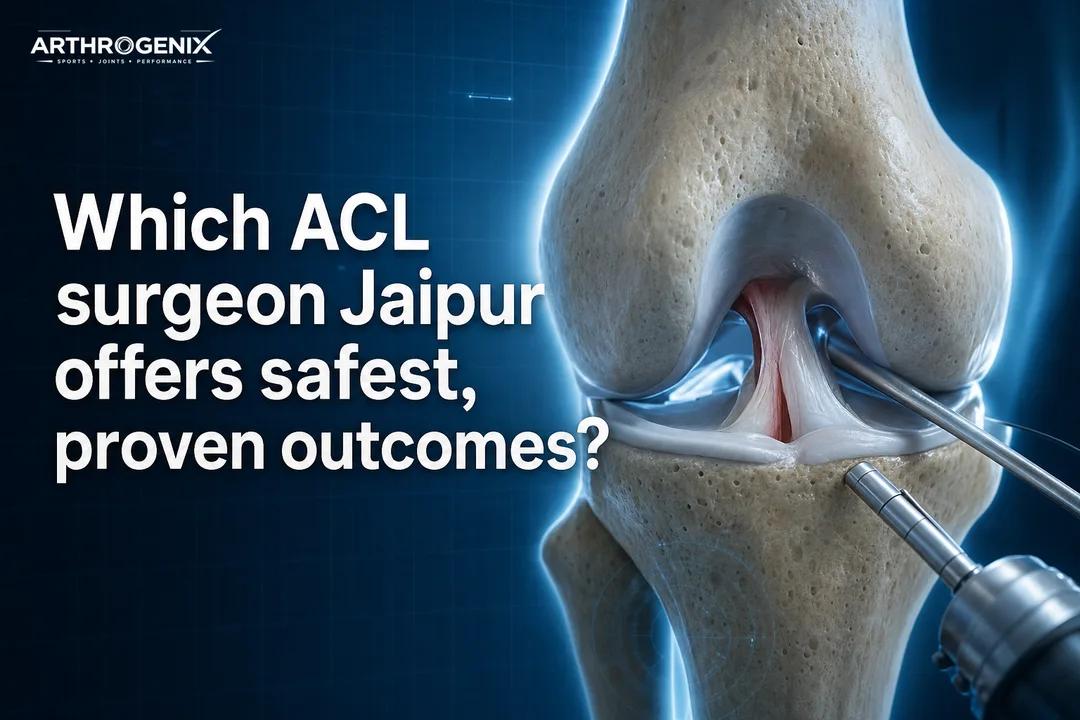
If you are asking, “Which ACL surgeon Jaipur offers safest, proven outcomes?”, you are already on the right path. Choosing the right expert matters. The decision will shape your recovery, your return to sport, and your long-term knee health. In this guide, you will learn how to evaluate an ACL specialist, which techniques support safer surgery, and why working with a sports orthopaedic surgeon who shows you objective results makes all the difference.
Fast, safe ACL recovery starts with the right team
As a dedicated sports orthopaedic practice in Jaipur, we see a clear pattern. Patients do best when planning, surgical detail, and rehabilitation align. That alignment reduces risk. It also speeds a confident return to activity. We build that alignment for athletes, active adults, and busy professionals who need a stable, pain-free knee for life and work.
From our experience at ArthroGenix, led by Dr. Abhishek Saxena, shoulder and knee arthroscopy done well is precise, minimally invasive, and paired with meniscus preservation when possible. Moreover, patients progress faster when rehab follows objective milestones. For example, we watch swelling, range of motion, and quadriceps strength symmetry, not just time on the calendar.
Importantly, proven outcomes never come from surgery alone. They come from the full pathway: accurate diagnosis, the right graft choice, careful tunnel placement, protected early loading, and return-to-sport testing. Therefore, you need a surgeon and team who can explain each step in plain language and show you how they measure success.
How to evaluate an ACL surgeon Jaipur for proven outcomes
Start with training and case volume. Fellowship training in sports medicine and advanced arthroscopy suggests focused expertise. Consistent case volume helps maintain fine technical skills. However, credentials alone are not enough. You also want transparency: What outcomes do they track? How do they decide grafts? How do they plan rehab?
Next, review technique. Modern ACL reconstruction uses arthroscopy with anatomic tunnel placement and graft tensioning. In addition, surgeons should aim to repair the meniscus rather than remove it when feasible. Preserving the meniscus supports shock absorption and long-term joint health.
Ask about return-to-sport readiness. According to AAOS patient guidance, returning to pivoting sports typically takes 9 to 12 months after ACL reconstruction, depending on strength and control milestones (AAOS overview of ACL injuries and treatment). Furthermore, a cohort study in the British Journal of Sports Medicine reported athletes who returned before 9 months had a 6.7 times higher risk of a second ACL injury (BMJ data on early return and reinjury risk). These are not scare tactics. They are real-world markers to protect your graft.
Finally, look for end-to-end safety. Sterile handling, VTE prophylaxis protocols, nerve monitoring where relevant, and infection control all reduce avoidable complications. Additionally, you want clear instructions for pain control, wound care, and early mobility. Results vary with anatomy, sport demands, and adherence, so no ethical surgeon will promise a one-size-fits-all outcome.
Questions to ask an ACL surgeon Jaipur during consult
Arrive prepared. Great decisions start with great questions. Use this short list in your consultation.
- Which graft do you recommend for my sport and age, and why?
- How do you protect and repair my meniscus during surgery?
- What objective tests must I pass before returning to sport?
- What outcomes do you track, and may I see your data format?
- How will you coordinate rehab and progress testing with my physio?
Safety and outcomes
Ask how the team measures infection risk, DVT prevention, and stiffness reduction. For instance, you might ask about their early-range-of-motion plan and how they limit swelling in week one. Also, discuss bracing strategy, weight-bearing guidelines, and how they taper pain medication while keeping you comfortable and mobile.
Techniques that reduce risk: arthroscopy, grafts, rehab
Anatomic, arthroscopic ACL reconstruction aims to restore native ligament function. Accurate tunnel placement and secure fixation limit graft stretch or impingement. Similarly, preserving the meniscus when viable helps protect cartilage integrity over time. When the meniscus must be repaired, guided rehab protects healing without sacrificing long-term function.
Graft choice carries trade-offs. Autografts (hamstring or patellar tendon) often suit young, pivoting athletes. Allografts may fit lower-demand patients or certain revisions. Evidence suggests that younger, high-demand athletes face higher failure rates with allografts than autografts. For a deeper dive on graft selection, see this NIH/PMC review (NIH/PMC review of graft choices for ACL reconstruction).
Rehab should be criteria-based. Moreover, your program should align with tissue healing and functional milestones, not arbitrary dates. In practice, that means reducing swelling quickly, restoring extension early, building quadriceps strength, and re-training movement patterns. As a result, you will earn your way from walking to jogging, then cutting and pivoting.
ACL reconstruction Jaipur: evidence-based choices
Informed consent includes understanding implant options, tunnel drilling strategies, and how your surgeon handles concomitant injuries like PCL sprains or cartilage lesions. For example, chondral damage may need cartilage procedures or careful loading progressions. Meanwhile, a bucket-handle meniscus tear often benefits from repair and a protected flexion plan early on.
Return-to-sport testing should check limb symmetry, hop tests, movement quality, and confidence. Therefore, a pass requires more than a strong quad. It requires sound mechanics under fatigue. Crucially, you should understand that trying to rush this stage increases reinjury risk. Patience here protects your long-term athletic life.
Why ArthroGenix stands out in Jaipur sports medicine
At ArthroGenix, Dr. Abhishek Saxena focuses on shoulder and knee arthroscopy, ACL and PCL reconstruction, meniscus repair, rotator cuff repair, shoulder arthroscopy, and joint preservation. Because we treat athletes and active adults daily, our approach balances surgical precision with practical rehab planning. We design care for your sport, your schedule, and your goals.
Here is what patients appreciate most about our Jaipur sports orthopaedic pathway:
- Evidence-led decisions: We explain the “why” behind each step.
- Meniscus-first thinking: We preserve and repair when possible.
- Minimally invasive arthroscopy: Smaller incisions and focused recovery.
- Criteria-based rehab: You progress by milestones, not by guesswork.
- Return-to-sport testing: Objective checks before you pivot and cut.
We welcome complex cases as well, including revision ACL, multi-ligament injuries, cartilage injury treatment, and shoulder instability. Additionally, when joint surfaces are too worn for preservation, we discuss options like knee replacement or shoulder replacement in clear terms. If you want to learn more about our philosophy and services, visit ArthroGenix. You can also explore care pathways and book a visit directly through our Jaipur sports orthopaedic practice.
When to see a sports orthopaedic surgeon
Consider a specialist appointment if your knee “gives way,” you feel a pop with swelling after a pivot injury, or your knee locks with certain movements. Likewise, if pain or instability limits work, training, or family life, a targeted assessment helps. Some patients improve with nonoperative care. Others need surgical stabilization to return to cutting sports safely. Clear testing will show what path suits your goals.
Patients also ask about timing. In general, allow swelling to settle and range to improve before surgery, unless your knee is locked by a displaced meniscus tear. Meanwhile, keep your quad active and your gait as normal as possible. These steps make surgery smoother and shorten your early rehab.
Choosing a surgeon in a busy city can feel daunting. However, if you follow the criteria in this article, you will find a partner who guides you through the entire journey. Above all, insist on a plan built on your sport, your anatomy, and your timeline.
In closing, proven outcomes come from details: precise arthroscopy, appropriate grafts, protected rehab, and honest checkpoints before return to play. If you are still wondering which path to choose, schedule a thorough assessment. Our team believes in careful diagnosis, transparent choices, and long-term joint health.
For patients comparing options, the question “Which ACL surgeon Jaipur offers safest, proven outcomes?” is not marketing. It is about trust. Therefore, ask the right questions, review the data, and choose a team that treats you like an athlete with a life to live, not just a knee to fix. This article comes from a Jaipur-based sports orthopaedic team that manages ACL injuries every week, and we are happy to help you make a confident decision.